It has been a tough summer. Attempting to introduce a new concept in specialty travel through Spirit of Remembrance has played both to my greatest strengths as well as some shortcomings. Despite this, I strongly believe in what I've been tasked to to; have had some wins with prospective clients and building a system of operations. There still is a lot of work to do, and that just gets me excited as to what the future holds.
If it has ever been your desire to walk through our country's war experience, there is no other firm that can bring you exactly the trip you intend to take, either one of our established offerings or a tour that we can help you build from the ground up. For further information, please follow the link above or contact me via my office email. I encourage you all to pay close attention because we are working towards some exciting new all-Canadian offerings.
As always, follow this space and get all sorts of updates and media from our Facebook Page and our Twitter Feed. If a Google search has brought you here, post your question in the comments section, and I will help provide the answer you might be looking for.
It has been, thought, a hard slog, and I've come close to giving up a couple of occasions. What as kept me going, beyond opportunity to work with a firm that suits my talents, or monetary reward, is that I've got good friends to call upon when I feel at a low ebb. There should be no surprise that many of those friends also have a military background.
This level of camaraderie is difficult to find outside of a service history. Reason being is that each one of us knows more than the average person that the value of individual is substantially less than that of the group; whether that be the section, platoon, company or regiment. So when I call upon my friends to help me out, they do so not only because they desire to help a fellow soldier, but by making me stronger and more capable benefits all of us on the whole; a process of of forging strength into weak links.
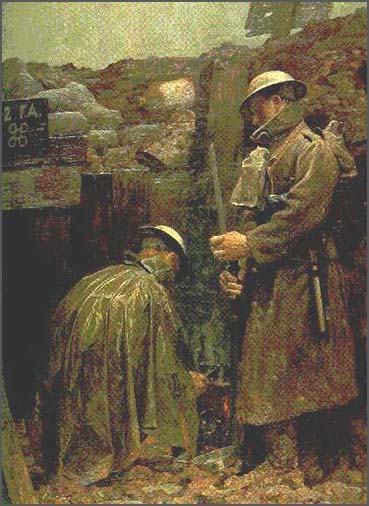
Which brings me back to a question I, and am certain many others have asked- How did the men endure the absolute Fifth Ring of Hell that was the Western Front of 14-18?
After the bunting came down, the flowers thrown at departing trains and the songs of bravado sung inspiring the population to the political necessity of the war faded, what was left to inspire human beings to go through the horrors of the battlefield, whether it be Badajoz, Beaumont-Hamel or Baghdad? Simple answer- one looks to their left and then to their right. These are the men with whom intimate experiences under extreme conditions are had. At this microcosm, higher ideals of King, country and democracy are too lofty and removed to think about. One carries on because he expects the same from his mates as much s they expect from him-that they will not let themselves down, and will not let their comrades down.
This reason alone is why one will charge a machine gun or fall onto a grenade. Not for personal glory, adulation or medals, but because the belief is that one's life has less value than that of the group to which one belongs; and everything must be done for the best interest of the many, even if that means the individual must be sacrificed.
No man is an island, and adversity shared is adversity easily overcome. I'm not the sort that makes friends easily, but I know, sure as I know anything that if I ever find myself facing a problem too overwhelming to cope with on my own, all I have to do is ask for help from my old comrades, and they will come through for me because they know I'd do the same.
The military, despite its purpose and direction of violence teaches us more about cooperative humanity than can be found elsewhere.
As a special note, for those that have helped me overcome a tough time, I'd like to extend my sincere thanks to Matt B., Tony B., Shannon B. & Ian T. Thanks, mates, for carrying me for when I couldn't carry myself. Above all, to my old and continuing comrades with the 48th Highlanders, who first showed me the value of such a lesson.
Take a moment, if you could to think of a topic you'd like to see presented in this column. Send your suggestions in the comments below. With Remembrance Week 7 weeks away, let's get some real interesting discussion topics we can all put thought towards.
Making Military History Accessible and Engaging in order to Forever Preserve the Memory of Sacrifice
If Ye Break Faith
This blog is dedicated to the promotion of educating about the Canadian experience of World War One. To discover who we are as a nation in the 21st Century, we must understand our past.
Sunday, 23 September 2012
Tuesday, 11 September 2012
We Are The Dead
After a long hiatus over the summer, I'm returning with a bit of a departure from the usual format. Regular posts expounding upon the First World War will resume shortly, but due to the nature of the date; I am presenting a short piece of fiction meant to inspire thought and reflection.
The Muezzin's call for morning prayer being sung from the small village half a click away amazed me. That an unamplified voice could carry so strong and far would give some drill instructors I know a run for their money.
That entreaty to speak with God was the last thing I heard.
The shaped charge ploughed through the sandbags in front of me, and who could blame it? It was designed to penetrate hardened steel.
And much as those that honour my memory; who saw me to my rest along that grey highway; there are those who decry my sacrifice. These are not those that killed me, but my own countrymen.
They say we shouldn't be there; that my comrades are fools. The irony is that they don't realise it is more for them than anyone else I put my life on the line- to ensure it is always a right the express oneself freely.
All that went before me, and those that died since have died for all of you. We shall not rest, and will continue to welcome those yet to die until the world can achieve the peace you protest for.
The Muezzin's call for morning prayer being sung from the small village half a click away amazed me. That an unamplified voice could carry so strong and far would give some drill instructors I know a run for their money.
That entreaty to speak with God was the last thing I heard.
The shaped charge ploughed through the sandbags in front of me, and who could blame it? It was designed to penetrate hardened steel.
And much as those that honour my memory; who saw me to my rest along that grey highway; there are those who decry my sacrifice. These are not those that killed me, but my own countrymen.
They say we shouldn't be there; that my comrades are fools. The irony is that they don't realise it is more for them than anyone else I put my life on the line- to ensure it is always a right the express oneself freely.
All that went before me, and those that died since have died for all of you. We shall not rest, and will continue to welcome those yet to die until the world can achieve the peace you protest for.
Monday, 4 June 2012
What Did You Do in the War?
My health having returned after a cycle of antibiotics, I'm back in fighting trim. I've been dedicating more and more time to my work with Spirit of Remembrance (SoR), and have begun a marketing campaign to introduce the business to potential customer bases in Canada. What this means for IYBF is that updates will now fall once a week, on Mondays. By all means if you or someone you know is interested in the offerings of SoR, or just wish further information, please send an email to my office inbox here. I am currently disappointed with Facebook who have decided to block links to blogger sites. What they've done by this is to severely limit my ability to promote my work effectively. Until this block is rescinded, or another means becomes available, you may still find updates and links via my Twitter feed.
History can be a touchy subject. Widely held preconceptions of events that do not align with fact are prime points of contention. Nobody likes having their illusions shattered by objectivity if they've been reliant on a subjective viewpoint. A prime example of this occurred just recently. A friend of mine expressed pride in one of her ancestors having been present at the Battle of Vimy Ridge. As she had no other information about his service, I volunteered to do a little ad hoc research to find out more. Through material freely available online through scanned archive records, and being able to place the soldier at a particular place and time, I was positive I could put together a brief synopsis of her relative's war service.
A common last name meant a short process of elimination to positively identify the man in question. His attestation paper, when viewed, revealed a truth very different from the one my friend had carried with her. Her relative had been conscripted under the Military Service Act (MSA) of 1917. He was taken on strength at the age of 22 on the 15th of May, 1918.
"He couldn't have been at Vimy." I stated.
"I didn't hear that." my friend replied, in denial. In fact, given information on the document it's very likely he never went overseas at all, but I didn't have opportunity to present that conclusion. My friend had stopped listening. I feel bad for offending her sensibilities, while at the same time her refusal to accept fact offended mine.
I can suggest reasons as to how this revision of personal history may have been created. Imagine how one who didn't participate in the war may have been ashamed of this in the face of adulation for returning veterans. Far better, in some cases, to be fast and loose with the truth to fit in rather than be judged harshly. Considering this individual was of military age before conscription was enacted, he may well have suffered a branding of cowardice or lack of patriotism, neither one an ideal label to live with in those times. As the generations proceeded, the false claim became an accepted truth, ingrained into the family history and is why the misconception is hard to let go of.
But it must be. First, because it ignores any actual contribution, no matter how small, this man made to history; and to continue to claim misinformation as truth devalues the efforts of those who were actually there. It is the same distaste I have as when I overhear a "barroom hero" regaling obviously false stories about their supposed military adventures as a means of attention getting.
It is precisely this type of selectivism which makes the prospect of the objective educational approach extremely difficult if not impossible; very few people are willing to abandon long held understandings even in the face of documented evidence to the contrary. I run into this constantly whenever I allege that the Battle of Vimy Ridge itself is far more inflated in the consciousness of Canadians than history makes allowances for.
For all of that, I am actually a bit of an apologist myself. I have, in this column many times referred to or referenced from Gordon Corrigan's excellent First World War examination, "Mud, Blood and Poppycock." It was several times I passed up reading it because the tag line promised "This will overturn everything you thought you knew about Britain and The First World War." Perhaps a bit closed-minded, I didn't want my knowledge overturned.
When I did finally read it, the way in which Corrigan presented and supported his arguments brokered no debate from me, and was my introduction to a more open minded approach to my study of history. Even after that, from time to time, I find that I still carry pre-conceived notions. As recently as last week, preparing to write "Not Quite the Ticket", I was sure that WWI was the last conflict in which disease mortality eclipsed combat fatalities, and was preparing my text along those lines. When I disseminated the hard facts, it was proven that my point of view was incorrect. I had to rework the intended angle of the piece, and failing to have done so would have resulted in a work subject to derision as my beliefs weren't supported by fact.
Objectivity is the goal of proper historic study. As the subject of history is tied into the human experience it is hard to let go of emotional connections which make objective thought difficult. Perhaps it is best to describe a complete understanding of history as a compromise between objective and subjective thought, with the precedence being given to the former rather than the latter.
History can be a touchy subject. Widely held preconceptions of events that do not align with fact are prime points of contention. Nobody likes having their illusions shattered by objectivity if they've been reliant on a subjective viewpoint. A prime example of this occurred just recently. A friend of mine expressed pride in one of her ancestors having been present at the Battle of Vimy Ridge. As she had no other information about his service, I volunteered to do a little ad hoc research to find out more. Through material freely available online through scanned archive records, and being able to place the soldier at a particular place and time, I was positive I could put together a brief synopsis of her relative's war service.
A common last name meant a short process of elimination to positively identify the man in question. His attestation paper, when viewed, revealed a truth very different from the one my friend had carried with her. Her relative had been conscripted under the Military Service Act (MSA) of 1917. He was taken on strength at the age of 22 on the 15th of May, 1918.
"He couldn't have been at Vimy." I stated.
"I didn't hear that." my friend replied, in denial. In fact, given information on the document it's very likely he never went overseas at all, but I didn't have opportunity to present that conclusion. My friend had stopped listening. I feel bad for offending her sensibilities, while at the same time her refusal to accept fact offended mine.
I can suggest reasons as to how this revision of personal history may have been created. Imagine how one who didn't participate in the war may have been ashamed of this in the face of adulation for returning veterans. Far better, in some cases, to be fast and loose with the truth to fit in rather than be judged harshly. Considering this individual was of military age before conscription was enacted, he may well have suffered a branding of cowardice or lack of patriotism, neither one an ideal label to live with in those times. As the generations proceeded, the false claim became an accepted truth, ingrained into the family history and is why the misconception is hard to let go of.
But it must be. First, because it ignores any actual contribution, no matter how small, this man made to history; and to continue to claim misinformation as truth devalues the efforts of those who were actually there. It is the same distaste I have as when I overhear a "barroom hero" regaling obviously false stories about their supposed military adventures as a means of attention getting.
It is precisely this type of selectivism which makes the prospect of the objective educational approach extremely difficult if not impossible; very few people are willing to abandon long held understandings even in the face of documented evidence to the contrary. I run into this constantly whenever I allege that the Battle of Vimy Ridge itself is far more inflated in the consciousness of Canadians than history makes allowances for.
For all of that, I am actually a bit of an apologist myself. I have, in this column many times referred to or referenced from Gordon Corrigan's excellent First World War examination, "Mud, Blood and Poppycock." It was several times I passed up reading it because the tag line promised "This will overturn everything you thought you knew about Britain and The First World War." Perhaps a bit closed-minded, I didn't want my knowledge overturned.
When I did finally read it, the way in which Corrigan presented and supported his arguments brokered no debate from me, and was my introduction to a more open minded approach to my study of history. Even after that, from time to time, I find that I still carry pre-conceived notions. As recently as last week, preparing to write "Not Quite the Ticket", I was sure that WWI was the last conflict in which disease mortality eclipsed combat fatalities, and was preparing my text along those lines. When I disseminated the hard facts, it was proven that my point of view was incorrect. I had to rework the intended angle of the piece, and failing to have done so would have resulted in a work subject to derision as my beliefs weren't supported by fact.
Objectivity is the goal of proper historic study. As the subject of history is tied into the human experience it is hard to let go of emotional connections which make objective thought difficult. Perhaps it is best to describe a complete understanding of history as a compromise between objective and subjective thought, with the precedence being given to the former rather than the latter.
Monday, 28 May 2012
Not Quite the Ticket
Boy howdy was I feeling rough last week. After a fantastic weekend parading with the RCAF Commemorative Squadron, by Wednesday I was coming down with a painful sore throat. This excuses my lack of an update last Thursday, while at the same time providing me with a topic I have yet to look over, that of disease during the war. I'm on the mend, after the doctor actually recoiled upon examining my irritated uvula and gave me an issue of antibiotics. Thankfully, my Twitter and Facebook feeds came in handy to inform about my inability to post; and it is my extraordinary pleasure that my suggested topic appeal to Oxford University's WWI Centenary Project enough for them to invite me to submit the following essay to their site.
I had gone over the treatment of battle casualties some time ago in my piece "The Blighty", which overlooked cases of illness or corresponding mortality rates. Communicable disease has always followed armies, were its spread has been encouraged by living communally in close quarters in dubious hygiene. We understand today more properly the relationship between physical hygiene and the spread of viruses and bacteria; and largely that understanding began to take root with the medical advances of the mid-nineteenth century, unironically expedited through the military conflicts of the time. Four times as many British soldiers died as a result of illness than did in battle during the Crimean War. Figures from the U.S. Civil War cite 224 000 deaths by disease and accident for the two million who served in that conflict. Each of these wars have their histories of diligent health care professionals who championed the cause of sanitation.
The popular notion of men on the Western Front being subject to terribly unsanitary conditions belie that the First World War is the first major conflict in which more service personnel were killed in action than by disease. Improvement in medicine and an enforced hygienic discipline in the trenches is one half of the reasoning behind this. The other has to do with a like advance in the technological methods of war which, cooly speaking, made inflicting casualties more efficient. For the British Empire, found in the "Casualties and Medical Statistics" volume of the Official History of the War, of 876 084 total deaths in WWI, some 113 173 were the result of "Disease or Injury", a ratio of 1/3 that of death in combat. Even then, the numbers for disease fatalities are eclipsed by both "Died of Wounds" (167 172) and, poignantly for the war, "Missing, Presumed Dead" (161 046).
The static nature of trench warfare actually allowed for a great attention to detail for preventative factors which helped curb the spread of disease. Prevention can only do so much against an extreme situation. Fortunately, with considerations in regards to both discipline and morale, the military system was well capable to administer to health concerns. From the timely removal of the dead for burial, a properly effective casualty clearing system, staunch rules for the construction and maintenance of trench latrines to a daily routine of policing up rubbish and wastage, life at the front was as healthy as could be under the duress of being the leading edge of battle.
The statistics listed above do not accurately encompass illness which did not become terminal. While sanitation at the front was better than supposed, the trenches were hardly pristine and our modern knowledge to how psychological stress effects the immune system gives rise that many hundreds of thousands of men suffered illness not quite serious enough to be excused from the line, or were stalwart enough to continue their duty when they should have sought treatment. Based upon the nature of moral and legal repercussions it can also be supposed that many more were suffering from venereal disease than reported. Even then, the records indicate 153 531 admissions for VD on the Western Front alone, accounting on average from year to year 24 cases per 1 000 men in theatre.
The rate of disease in armies during WWI was often predicated by locale. For the British, by far the worst theatre was that of East Africa where unfamiliar heat and a range of tropic ailments felled thirty one men for each soldier killed in action.
Not to be overlooked is the devastating influenza pandemic which first appeared on the Western Front via Spain by mid 1918. It caused for the British between October and November of that year 45 000 patient admissions at a mortality rate of six per cent. The flu began to spread perniciously at the unfortunately co-incidental advent of the Armistice. The diaspora of demobilized soldiers back to homes around the world communicated the virus to untold millions. Exact figures on how fatal the Spanish Flu was are still uncertain, though from what we do know it is one of the most disastrous plagues in modern history.
Because of the incidences of disease amongst soldiers, medical improvements which occurred as a result of necessity in the war do not solely reflect treatment of combat wounds. They also inspired practices in treatment and, more importantly, prevention of spreadable diseases. Despite the horror and loss of the years 1914-18, one of the positive results was a general increase in standard of health which prepared the way for many national systems of public healthcare.
I had gone over the treatment of battle casualties some time ago in my piece "The Blighty", which overlooked cases of illness or corresponding mortality rates. Communicable disease has always followed armies, were its spread has been encouraged by living communally in close quarters in dubious hygiene. We understand today more properly the relationship between physical hygiene and the spread of viruses and bacteria; and largely that understanding began to take root with the medical advances of the mid-nineteenth century, unironically expedited through the military conflicts of the time. Four times as many British soldiers died as a result of illness than did in battle during the Crimean War. Figures from the U.S. Civil War cite 224 000 deaths by disease and accident for the two million who served in that conflict. Each of these wars have their histories of diligent health care professionals who championed the cause of sanitation.
The popular notion of men on the Western Front being subject to terribly unsanitary conditions belie that the First World War is the first major conflict in which more service personnel were killed in action than by disease. Improvement in medicine and an enforced hygienic discipline in the trenches is one half of the reasoning behind this. The other has to do with a like advance in the technological methods of war which, cooly speaking, made inflicting casualties more efficient. For the British Empire, found in the "Casualties and Medical Statistics" volume of the Official History of the War, of 876 084 total deaths in WWI, some 113 173 were the result of "Disease or Injury", a ratio of 1/3 that of death in combat. Even then, the numbers for disease fatalities are eclipsed by both "Died of Wounds" (167 172) and, poignantly for the war, "Missing, Presumed Dead" (161 046).
The static nature of trench warfare actually allowed for a great attention to detail for preventative factors which helped curb the spread of disease. Prevention can only do so much against an extreme situation. Fortunately, with considerations in regards to both discipline and morale, the military system was well capable to administer to health concerns. From the timely removal of the dead for burial, a properly effective casualty clearing system, staunch rules for the construction and maintenance of trench latrines to a daily routine of policing up rubbish and wastage, life at the front was as healthy as could be under the duress of being the leading edge of battle.
The statistics listed above do not accurately encompass illness which did not become terminal. While sanitation at the front was better than supposed, the trenches were hardly pristine and our modern knowledge to how psychological stress effects the immune system gives rise that many hundreds of thousands of men suffered illness not quite serious enough to be excused from the line, or were stalwart enough to continue their duty when they should have sought treatment. Based upon the nature of moral and legal repercussions it can also be supposed that many more were suffering from venereal disease than reported. Even then, the records indicate 153 531 admissions for VD on the Western Front alone, accounting on average from year to year 24 cases per 1 000 men in theatre.
The rate of disease in armies during WWI was often predicated by locale. For the British, by far the worst theatre was that of East Africa where unfamiliar heat and a range of tropic ailments felled thirty one men for each soldier killed in action.
Not to be overlooked is the devastating influenza pandemic which first appeared on the Western Front via Spain by mid 1918. It caused for the British between October and November of that year 45 000 patient admissions at a mortality rate of six per cent. The flu began to spread perniciously at the unfortunately co-incidental advent of the Armistice. The diaspora of demobilized soldiers back to homes around the world communicated the virus to untold millions. Exact figures on how fatal the Spanish Flu was are still uncertain, though from what we do know it is one of the most disastrous plagues in modern history.
Because of the incidences of disease amongst soldiers, medical improvements which occurred as a result of necessity in the war do not solely reflect treatment of combat wounds. They also inspired practices in treatment and, more importantly, prevention of spreadable diseases. Despite the horror and loss of the years 1914-18, one of the positive results was a general increase in standard of health which prepared the way for many national systems of public healthcare.
Thursday, 17 May 2012
By the Left, Quick March!
In an effort to expand my professional network to include as much of my potential market as possible, I called upon an old college friend to help supply some contact information. As it turns out, this friend is heavily involved in a living history group: The Royal Canadian Air Force Commemorative Squadron. In the past, I've been keen on living history and interpretation groups but have had little opportunity to participate. That will change this Saturday when I shall join the RCAFCS for a goodwill parade in Kingston, Ontario.
What this raises is an interesting problem. I haven't had to do any parade drill in well over a decade. Notwithstanding, of course, the subtle differences between air force and army drill, there is also the changes to the movements made between the era I will be representing and the era in which I served. Primarily among these discrepancies is the order "slope arms", the act of resting the rifle on the left shoulder, which went out of style half a century ago. Lacking a rifle to practice with prior to the parade, I am, unironically, teaching myself these movements with a broom.
It was thinking on this which led me to think about drill on the whole, especially its development and purpose. When foot drill was developed centuries ago, it had a direct and practical purpose. The need was to be able to manoeuvre large bodies of men, precisely, into the most advantageous position on the field of battle. To do this quickly, and more important, impressively might even be enough to inspire the opposing force to quit the field without fighting. Should battle be joined, the discipline instilled by repeated practice of responding immediately to words of command could be enough to hold the line when the chaos of combat descended.
By the turn of the last century, the use of foot drill as battle craft had gone out of practical fashion. It had become, by and large, a ceremonial practice, but it was still taught at the very basic level of military indoctrination. On the surface it appears as if soldiers are being instructed at great length and effort to perform movements which might look grand on the parade square, but of no actual tactical value.
This attitude persists today in the grumbling of recruits struggling with the unfamiliar and sometimes complex movements which drill requires. "Why are we learning this?" is something I've heard quite often, usually coupled with the assertion that the new soldier is destined to be up at the sharp end and has no intention of fulfilling any ceremonial function for which drill would be necessary.
Fact is, that although the need to march men stiff-backed and high stepping upon a battlefield has long since passed, the other purpose remains, and remains integral to the function of an armed force: That of discipline.
This is first apparent physically, mainly for the need to be completely aware of one's entire body and the execution of isolated movement. Learning in groups with the goal of precise unison gives a standard to achieve among equals and is the first instillation of the military truism of team above individual.
The method by which drill is taught seeks to create an automatic response to short cues. A difficult concept in a free thinking society, it is crucial and life-saving in the field.
It is not only physical discipline, or indoctrination to military authority; based on orienting terms such as "advance", "retire", "left" and "right" where it's possible to move to the right by means of a left turn, candidates must think in what at first seems the contrary. Drill then becomes a mental discipline which requires the student to think quickly to initially unfamiliar prepositions. Through first an impeccable example in the instructor, repetition and constant correction one learns to yearn for achievement, help comrades, inspire confidence, and take pride in appearance.
On today's modern battlefield, some of the same aesthetic similarities in condition exist in parallel with the entire history of warfare: Fear, confusion, the necessity to make the right decision and follow through faster than one's enemy. All of what drill inspires counters the former two and gives ability for the last.
Monday, 7 May 2012
No Man's Land
It's been just about a year since "If Ye Break Faith" debuted. At first, all I thought I required was some space to share my passion of military history and showcase my writing for publishers entertaining proposals of the printed work which was to be generated. Success at this didn't immediately matter to me, the real value "If Ye Break Faith" gave to me was the opportunity to focus on something I was passionate about while all around me was chaos.
As time went on and this space began to pick up momentum, and even more fantastic, an audience, it was apparent to me that I had, almost by accident, created something that had value; and validation. What remained for me was to find the fight direction and method to the project and see that it got there. There's been several models for IYBF as a business, and none of them have been quite right, or I've lacked the know-how to actualize. I've come close to, up to announcing it at times, giving up. The frustration being that I'm so full of effort and energy with the study of history and its perpetuation, but I kept falling short of my goals.
Here we are, a year later, and things are on the move. I've had some very pleasant conversations with a business dedicated to the same purpose of promoting remembrance. I can't describe how exciting the idea of collaborating with them would be. Nothing is set in stone, yet, but details will be coming hard and fast once the go-ahead is given. It's very thrilling stuff, I promise. Keep up to date with us on Twitter and Facebook to make sure you don't miss a beat.
Weeks ago, I was stuck for a topic to expound on. Nothing quickly came to mind, and I worried about running out of momentum. I've solicited for suggestions in the past, with minimal success (you can submit ideas questions or comments here, by the way). The fortunate thing is that I have at my disposal the statistics for search terms which have resulted in a site hit. Based on many of the highest scoring terms, I can posit that I've been helping students with their homework, but in a way that I don't like.
For all time the search term most used in finding this site is "No Man's Land." No term could be more ubiquitous to the First World War. It is so commonly understood that the term itself is indexed only once in a dozen selected histories (ie: the books on WWI that I own.) It is evocative not just because the term defines what it does, but mainly by the way the words "No Man" conjure up sparsity, vacancy, death.
The use of the phrase pre-dates the war, defining the ground between two properties that belonged to neither land holder. It was a fitting transfer from that to its better known usage; the land between two contesting armies after they had assumed mutually defensive positions.
When the momentum of open war and manoeuvre faltered and stalled, creating through France and Belgium the trenchlines and fortifications known as the Western Front, the land over which the infantry would have to cross to bring the fight to the enemy took on its nom-de-guerre. Distance varied with the disposition of the lines, from hundreds of meters at its widest; narrower points measured tens of meters.
Despite its depth, or lack of, moving openly on this ground was to court death. No defensive position is sited or occupied without the defenders prepared to bring fire down on all the approaches. In a set battle, the risk was offset by covering artillery meant to keep the opposing force from resisting an advance and there are four years of example as to how well this process worked in an extended exercise of trial and error bought and paid for in human lives.
No Man's Land was so closely watched that a moment's exposure above the trench line could invite a sniper's bullet or give a trench mortar team something to aim at. May as well, then, stay down and unseen until going over the top was no longer optional.
If only it were that simple. Trenches need a lot of maintenance, particularly if they've been subject to shelling; the wire obstacles fronting the firing lines needed to be checked and repaired daily; and it is of crucial importance to know that the enemy is up to, even if he's only a few yards away. Like the unnatural reverse of living below ground which trench warfare created, the nature of No-Man's Land insisted that work be done at night.
At last light, there would be a "stand to" where everyone on the firing line was standing ready at arms to repel an attack. After sunset, and stand down, the real work began. Fatigue parties would move forward to make repairs of trench and wire, working as quietly as possible, their efforts slowed by standing still each time a flare was sent to illuminate the ground. Patrols would also slip out, to close the distance and view the enemy's capabilities, grab a prisoner for questioning or to cause a little mayhem before returning to friendly lines. Some patrols would find the right lay of ground, camouflage it and remain as an observation post in No-Man's Land for days.
As the war went on, and the same land was contested, the area between the trenches became more un-worldly: no buildings stood, no trees grew, only mile upon mile of churned earth and the wastage of war. This vision, the black and white landscape of shell-holes and mud is the one usually playing in the cinema of the mind; a place foreign, forbidding and deadly. Yet it still has to be gotten across.
I can empathize a bit with the spirits of the war, standing dry-throated and unblinking at a wide, bare land. "If I stay here," is the shared thought, "I may be safe. If I move forward, the risk of harm is great." As things develop for me, I face my own No-Man's Land, represented in the steps I have to take to reach my goal; there's every possibility in which I can falter or fail.
If these men I admire had not made their crossing to engage the enemy, the war could not have been won. To "win" my struggle, I too must set off over unknown and potentially dangerous ground. If only I had half their courage.
As time went on and this space began to pick up momentum, and even more fantastic, an audience, it was apparent to me that I had, almost by accident, created something that had value; and validation. What remained for me was to find the fight direction and method to the project and see that it got there. There's been several models for IYBF as a business, and none of them have been quite right, or I've lacked the know-how to actualize. I've come close to, up to announcing it at times, giving up. The frustration being that I'm so full of effort and energy with the study of history and its perpetuation, but I kept falling short of my goals.
Here we are, a year later, and things are on the move. I've had some very pleasant conversations with a business dedicated to the same purpose of promoting remembrance. I can't describe how exciting the idea of collaborating with them would be. Nothing is set in stone, yet, but details will be coming hard and fast once the go-ahead is given. It's very thrilling stuff, I promise. Keep up to date with us on Twitter and Facebook to make sure you don't miss a beat.
Weeks ago, I was stuck for a topic to expound on. Nothing quickly came to mind, and I worried about running out of momentum. I've solicited for suggestions in the past, with minimal success (you can submit ideas questions or comments here, by the way). The fortunate thing is that I have at my disposal the statistics for search terms which have resulted in a site hit. Based on many of the highest scoring terms, I can posit that I've been helping students with their homework, but in a way that I don't like.
For all time the search term most used in finding this site is "No Man's Land." No term could be more ubiquitous to the First World War. It is so commonly understood that the term itself is indexed only once in a dozen selected histories (ie: the books on WWI that I own.) It is evocative not just because the term defines what it does, but mainly by the way the words "No Man" conjure up sparsity, vacancy, death.
The use of the phrase pre-dates the war, defining the ground between two properties that belonged to neither land holder. It was a fitting transfer from that to its better known usage; the land between two contesting armies after they had assumed mutually defensive positions.
When the momentum of open war and manoeuvre faltered and stalled, creating through France and Belgium the trenchlines and fortifications known as the Western Front, the land over which the infantry would have to cross to bring the fight to the enemy took on its nom-de-guerre. Distance varied with the disposition of the lines, from hundreds of meters at its widest; narrower points measured tens of meters.
Despite its depth, or lack of, moving openly on this ground was to court death. No defensive position is sited or occupied without the defenders prepared to bring fire down on all the approaches. In a set battle, the risk was offset by covering artillery meant to keep the opposing force from resisting an advance and there are four years of example as to how well this process worked in an extended exercise of trial and error bought and paid for in human lives.
No Man's Land was so closely watched that a moment's exposure above the trench line could invite a sniper's bullet or give a trench mortar team something to aim at. May as well, then, stay down and unseen until going over the top was no longer optional.
If only it were that simple. Trenches need a lot of maintenance, particularly if they've been subject to shelling; the wire obstacles fronting the firing lines needed to be checked and repaired daily; and it is of crucial importance to know that the enemy is up to, even if he's only a few yards away. Like the unnatural reverse of living below ground which trench warfare created, the nature of No-Man's Land insisted that work be done at night.
At last light, there would be a "stand to" where everyone on the firing line was standing ready at arms to repel an attack. After sunset, and stand down, the real work began. Fatigue parties would move forward to make repairs of trench and wire, working as quietly as possible, their efforts slowed by standing still each time a flare was sent to illuminate the ground. Patrols would also slip out, to close the distance and view the enemy's capabilities, grab a prisoner for questioning or to cause a little mayhem before returning to friendly lines. Some patrols would find the right lay of ground, camouflage it and remain as an observation post in No-Man's Land for days.
As the war went on, and the same land was contested, the area between the trenches became more un-worldly: no buildings stood, no trees grew, only mile upon mile of churned earth and the wastage of war. This vision, the black and white landscape of shell-holes and mud is the one usually playing in the cinema of the mind; a place foreign, forbidding and deadly. Yet it still has to be gotten across.
I can empathize a bit with the spirits of the war, standing dry-throated and unblinking at a wide, bare land. "If I stay here," is the shared thought, "I may be safe. If I move forward, the risk of harm is great." As things develop for me, I face my own No-Man's Land, represented in the steps I have to take to reach my goal; there's every possibility in which I can falter or fail.
If these men I admire had not made their crossing to engage the enemy, the war could not have been won. To "win" my struggle, I too must set off over unknown and potentially dangerous ground. If only I had half their courage.
Thursday, 19 April 2012
Known Unto God
Thanks to all for standing by. Once again, I'd like to offer sincere apologies for there not being an update on Monday. It is especially unfortunate that this is due to my internet provider, Wind Mobile and their appalling customer service. I've registered a complaint against them with the Better Business Bureau and advise my Canadian readers to avoid giving them their custom. If I could afford any other service, I would have voted with my feet long ago, but necessity is what it is.
I've been enthusiastically working on the article I've been invited to submit to a Canadian periodical. I'll give more details soon, but don't wish to speak out of turn until I've got the go-ahead from the publisher. Let's just say this: It is a tremendous opportunity for me, and more importantly for this body of work.
You can keep up to date with developments through out presence on Facebook and Twitter. As always, comments questions and suggestions can be forwarded here.
Via one of our followers is a link to the Australian War Graves Photographic Archive, an effort to preserve through images the resting places of Australia's war dead. This brought me to consider the roots of "If Ye Break Faith" and its primary purpose to perpetuate the memory of the fallen.
There is a melancholy sentimentality to those killed in the First World War, perhaps due to the indecisive nature of the conflict, but owing mostly to the contemporary shock at the unprecedented loss of life. It is estimated that the war is responsible for a figure of 15 million dead, both civil and military. The most difficult aspect of these deaths were the large numbers listed as missing and whom still today have no known grave. There are few things more evocative in
the history of human conflict than the three words "Known Unto God."
It is a practical necessity as well as human sentiment to inter the dead as soon as possible. Quite frequently fatal casualties were given a quick burial, then later re-buried when proper cemeteries were established. For convenience, many of these were built near casualty posts though not altogether too near. There were considerations for both hygiene and the psychological health of wounded expected to recover that the dead be kept separate as situationally possible.
But it is the very nature of the war which is responsible for the lack of identification for so many lives lost. The dangers of crossing No Man's Land made it difficult or impossible at times to retrieve the dead. There were local cease-fires arranged from time to time to bring the fallen in, such as that between the ANZACs and Turkish forces at Gallipoli on 24May 1915. The other part to this question is quite simply that the prime cause of casualties in the war was artillery fire. Shrapnel and high explosive shells often do not leave intact corpses; buried men under collapsed trenches or bunkers and even more gruesomely would disinter men already buried, confusing the identification process further.
What the large numbers of missing and unidentified did was add to the sense of the war lacking closure, and had a profound effect on those who had no answer as to what happened to a loved one lost.
After the war, the former belligerents made tremendous efforts to establish permanent resting places for those killed, and commissioned monuments to the missing such as those found at Theipval, Vimy and the Menin Gate. Today, organisations such as the Commonwealth War Graves Commission continue to maintain these monuments and markers, as well as undertake efforts to identify remains.
Many countries have tombs dedicated to
unknown soldiers, the unidentified remains symbolically representing all from
that country who’s bodies have not been recovered or identified. For Canada alone, between the First and
Second World Wars and the Korean Conflict there is an estimated 28 000 service
personnel Killed in Action who have no known grave.
Last year,
that number was reduced by one upon the positive identification of Pte
Alexander Johnston, a handyman who lived in Hamilton, Ontario killed while
serving with the 78th Battalion (Winnipeg Grenadiers) 12 Brigade, 4th
Canadian Division on the 29th of September 1918.
The 78th
Battalion had been on the Western Front since August of 1916, Johnston joined
them early in September 1918 after his conscription under the Military Service
Act in January of the same year. Less
than a month later, after heavy and near continuous fighting in the campaign
known as “The Hundred Days”, Johnston would be dead; one of 30 000 casualties
in the first phase of operations. “The
Hundred Days” offensive would carry on until the Armistice in November and
Johnston would remain missing for a further ninety years.
On
the 26th of September 1st and 4th Canadian
Divisions moved into starting positions on the western bank of the Canal du
Nord, an incomplete artificial waterway running roughly north-south at appoint
east of the small town of Barille. Here
the canal was not overlooked by the enemy as it was further north; the
crossing, down one high embankment to the other on the eastern side was dry as
well. The only detraction was the
crossing point was far too narrow to allow a general advance. At zero-hour, 0520 27 September, Canadian
artillery began shelling German lines. Shortly after: “four battalions of the 1st
and 10th Brigades dashed across the dry canal bed. Light opposition on the east bank was rapidly
overcome, and within an hour a 2000-metre-deep bridgehead was firmly held.”
(Marteinson, 200) Now, follow up units
could pass through and continue towards the objective city of Cambrai.
The 4th
Division was held up by dedicated enemy resistance from the direction of
Bourlon Wood. Flanking units from the
XVII Corps of 3d British Army had not kept pace, requiring 11 and 12 Brigades
to clear the heights surrounding the wood, which they accomplished by
2000hrs. (Marteinson, ibid)
The next day,
the 78th Battalion had consolidated along the Douai-Cambrai Road in
preparation for the advance on Cambrai itself.
The Battalion War Diary cites “stiff resistance...and heavy shelling”
throughout the day. It was during this
shelling that Pte Johnston was killed. Once Johnston
was listed as killed, his next-of-kin would have been informed, but with the
disturbing news that his body could not be found. It wouldn't be until an excavation for a
construction project in 2008 disinterred his remains that his journey into
recognition would begin. The lands of
the Western Front still surrender vast amounts of physical history; from the
hundreds of tonnes of unexploded munitions collected each year known as the
“Iron Harvest”, to geographical features such as bunkers and trench lines, an
unthinkable amount of human remains and countless other artifacts.
Even when a
body is found, identification is not a guarantee. In Johnston’s case, badges known as “collar
dogs” helped to place the body with a
particular unit. There is then a process
of elimination to narrow the field to as few probable candidates as
possible. DNA samples between the body
and potential living relatives are compared to give a positive ID. This process, pending the availability of
information, takes years to complete; undertaken by dedicated researchers and
volunteers. Pte Johnston wasn’t
identified until last year, and was buried with full military honours
at Cantimpre Canadian Cemetery in Sailly lez Cambrai, France on 26th
October 2011 with a handful of his surviving relatives in attendance.
The
difficulty is that Pte Johnston is a rare case.
Despite the amount of remains and artefacts found each year, the odds of
identifying a body from hundreds of thousands of candidates after nearly a
hundred years are long indeed; and that is pending having enough evidence on
hand to begin the process.
For one
family this gives a piece of closure in a war that has a notorious reputation
for lacking closure. It is only through
the continued efforts put forward by various museums, universities, departments
of defence and civil projects from many different nations that give us the
opportunity to more completely understand our past.
The ambiguity
of the Great War persists through the vast amount of missing information which
will never be part of a complete picture of events. If, though, as a society we choose to push
beyond our past without as thorough an understanding we can build, not only do
we stand to lose the lessons history has to teach us, we also abandon any hope
that more lost soldiers will get to go home.
Sources
Marteinson, John “We Stand on Guard” Ovale Publications,
1992
Subscribe to:
Posts (Atom)