If Ye Break Faith

This blog is dedicated to the promotion of educating about the Canadian experience of World War One. To discover who we are as a nation in the 21st Century, we must understand our past.


Monday, 4 August 2014

Who We Were and Who We Are

It is August 04, 2014.  Exactly one hundred years ago, Britain declared war on Germany.  For Britain and her Empire the Great War was about to begin.  I have found a great deal of confusion in comments posted to Canadian sites reporting on this anniversary.  Mostly, there seems to be a lack of understanding of why Canada became involved in the war, and what possible benefit was gained from this experience.  I have endeavoured to address these questions below.

In all the build-up to the centenary there has been no shortage of interesting tributes, projects and memorials being announced.  As many of you know, "If Ye Break Faith" was begun to be part of this effort by providing a means to memorialise the Canadian fallen of the war.  It has come to my attention that the Royal British Legion has just last week made available "Every Man Remembered", an online repository of publicly contributed tributes and biographies of all Commonwealth soldiers killed in World War One.  As this is remarkably similar to what I had in mind to create, I find that I must seriously rethink the purpose of "If Ye Break Faith" to avoid any intellectual property issues, while at the same time being a really good sport and throw my full support behind the Legion's efforts.  As always, you can keep up with things as they develop by following on Twitter and Facebook.

When the house of cards that was European peace through strategic alliances finally collapsed, public interest domestically was certainly piqued.  If not at first for news that the argument between Austro-Hungary and Serbia had spilled out over the continent, it was almost certainly the speculation on what Britain would choose to do.  Thoughts of this nature were more than a distracted concern.  Canada was a very different entity, both politically and demographically a century ago.  What is now a mostly titular and symbolic connection to the United Kingdom was in 1914 a more rigid and formal relationship.  Since Confederation in 1867 Ottawa had gained wide freedoms in domestic affairs, but the Crown retained, among other things, control of foreign policy.  Thus what happened to Britain in this unfolding crisis would happen to Canada as well.


The ultimatum requiring Germany to withdraw from Belgium expired without compliance and Britain was forced to act.  London’s Parliament approved and delivered a declaration of war to the Kaiser’s representatives on the 4th of August.  A telegram making note of this was sent out to the Dominions.  It is recorded in an extra edition of the Canada Gazette that the Duke of Connaught, Governor General of Canada received this notice at 8:45 pm on the same day.  Parliament was immediately recalled by royal order.  The HMCS Rainbow and Niobe were directly seconded to he Royal Navy; their officers and crew immediately placed under the laws of Active Service[1].  Canada was going to war.

While the ability to decide such matters was beyond the power of the national government, Canada’s decision on how to contribute to the war effort was entirely its own.  There was, however, little doubt what that level of commitment would be.  The population at the time was predominantly British- either by birth or recent descent.  Support for what many considered “the home country” was overwhelming.  With news breaking of the declaration, the already holiday atmosphere of a long summer weekend became one of jubilant celebration as “tens of thousands of Canadians took to the streets.”[2]   This attitude was reflected in the political speeches given at the announcement, Prime Minister Robert Borden promising to “put forward every effort and make every sacrifice necessary to the integrity and maintain the honour of our Empire.”  Opposition leader Sir Wilfred Laurier made his now famous statement “When the call comes, our answer goes at once, and it goes in the classical language of the British answer to the call of duty, ‘Ready, aye, ready!’”[3]  It is revealing of the sense of nationality at the time that the possessive pronouns relating to Britain and Empire in both speeches are in the collective first person.  Even before Parliament solidified the exact nature of this intent, recruits were already beginning to volunteer.

Ottawa followed through on the rhetoric of both party leaders authorising an expeditionary force of  25 000, appropriating $50 million for its equipment and training and a resolution to provide for all costs associated with Canada’s war effort.  This assumption of fiscal responsibility may have incurred Canada’s first national debt, but also allowed for tremendous growth in domestic investment and industry.  As the war grew in length and breadth the demand for goods manufactured or produced in agriculture accelerated.  Britain as head of the Empire could not alone meet the material needs of so large a conflict.  Foreign demand for exports would help provide the capital to improve infrastructure, not the least of which was a substantial increase in railway mileage.  It was rail that linked the country in the decades after Confederation and expansion of transportation would strengthen that bond; more deeply unifying the country in a physical as well as ideological sense.

Two thirds of the First Contingent was British born, and Britons would never number less than half of those serving in Canadian uniform throughout the war.  The men who went to war from Canada may have considered themselves British, but their experiences overseas would serve as a catalyst to change the prevalent sense of identity held before 1914.  In a speech commemorating the start of the war, Chief of Defense Staff General T.J. Lawson said “The war affirmed that Canada is unavoidably part of the international system.”  At the same event, historian Margaret MacMillan agreed that due to the war “Canadians became more conscious of our country as a nation- of our contribution to the world.  This outcome allowed Canada to become more independent.”  Due in no small part to an esteemed reputation for efforts in battle and a reciprocal esprit de corps from this adulation, the men of the CEF began to take pride in being and identifying as Canadian.  There was a noticeable shift in population demographic in the years following the war.  While the origin of immigrants was still majorly British, for the first time since 1867 population growth was more from natural increase, outpacing migratory growth by a factor of nearly ten to one by 1920.[4]  Descendents born to the war generation would carry on this pride of being Canadian, supplanting the pre-war mindset of British subjectivity almost completely.

The war, particularly as it moves further away from us in time can not be easily understood.  It can never be easy with modern sentiments gained through a century’s social progression to comprehend Canada’s subordinate position in global affairs or the enthusiasm of those who rushed to volunteer.  However as who we are now is indelibly tied into this experience of our past it is crucial to make that understanding.  General Lawson tells us that “World War One is a story of individual sacrifice for values still held through the thread f one hundred years.”  Those that returned to Canada with a growing sense of nationality took great pains to ensure those values for which so much was sacrificed would become intrinsic to this young country.  Their desire to move beyond the tragedy of war, their efforts to create a better world helped to shape Canada.

One hundred years on and the nature of the country has changed again.  The ratio of migratory to natural population increase has reversed.  Canada has become a more multi-ethnic country, moving further away from our British-centric roots.  This in itself has been a gift to Canada’s growth and leant to a deeper and progressing notion of our national identity.  Though there are fewer here today that have a generational link to Canadians of the Great War the ideals for which they fought-freedom, fairness, equality and justice- are still a large part of who we are.  In a reversal of Borden and Laurier using possessive language towards Britain in 1914, one hundred years later Canada’s top General addressed all Canadians, no matter of origin “I urge you to discover your history for yourselves- it’s yours, own it.”  Whether we were born here or have just arrived when we say we are Canadian we inherit the legacy left to us of all those who went before us and particularly that of the men of the CEF.


[1] Canada Gazette, Wed. 05 August 1914
[2] Cook, Tim At the Sharp End Penguin Group (Canada) 2007 pg. 21
[3] Quotes taken from: Morton/Granatstein Marching to Armageddon Lester & Orpen Dennys 1989 pg. 6
[4] Statistics from a table developed by Claude Bélanger, Marianopolis College

Tuesday, 22 July 2014

Lest We Forget (but only if we're remembering correctly)

We find ourselves now at a point of a matter of days from the centenary of the start of the First World War.  About a year ago I wrote a short piece on the upcoming event and how it was going to be observed.  Time now, I should think, to revisit this topic.  I may ruffle some feathers and offend some sensibilities, but that is entirely a good thing as far as I'm concerned, because I am indeed concerned.  As always, I welcome your thoughts and comments which you can leave below, or follow me via Twitter and Facebook.

Circumstances have put me in a surprisingly advantageous position.An illness last year took me away from being able to dedicate time and energy to the growth of this project, which was then compounded by a busy work schedule once I was well.  These two things caused If Ye Break Faith to remain idle and grow stagnant, even to the point of missing out on a very good opportunity for advancement.  Recently, an accident which resulted in several broken bones has given me a wealth of spare time.  What better to do, especially now, than to rededicate myself to IYBF?  I very much announced this in my last post and have the availability to pay attention to First World War items in the media and keep my social networks active by linking to relevant articles.  I'm also writing articles of my own for publication beyond this space.  The purpose is, of course, to build a portfolio that will help in the sale of my first full length print work, which is coming along well, thanks for asking.

What I've noticed, and what I want to touch on, is the sheer volume of articles, photographs, videos and television documentaries and how some of them are choosing to portray events of a hundred years ago.  Leading up to the centenary the public debate is how it should be observed.  What this has become is a dichotic mix of opinion in these recent media offerings.  I am not going to place myself in one camp or the next.  It is my belief that the First World War was an event that can be attached to many types of emotive reflection.  What I will not abide is the use of poor research, inflamed rhetoric or reliance on supposition rather than fact to influence the general perception of the war or reinforce incorrect assumptions about it.

I had been awaiting the broadcast of a new 5 part documentary on the war presented by TVO (TV  Ontario, a public channel) titled "Apocalypse:  The First World War".  It promised rare and unseen archival footage given new life through colour and sound digitally added.  As there isn't a lot of motion picture records of the war, I'm very keen to see something new.  I was not impressed by what I watched.  Written by two people with no solid background in military history, the narration made several mistakes of fact and had a decidedly pronounced bias based upon assumptive errors which skated rather close to a political agenda.  History is not so clear cut as this program portrays as to even begin to support such one-sided thinking.  Here, though, is my problem:  I consider myself quite an expert on the war and so can readily spot errors or bias.  The average  person is not, and will take such messages as true representations and thus have an incomplete and disturbed view of such an important event in human history.  This reinforcement of incorrect understanding is damaging and difficult to redress.  A recent article by historian Dan Snow illustrating the historical facts of some widely believed myths of the war resulted in the author receiving harsh criticism, even threats.  While at the same time, another historian whom I will not name, is posting well praised articles so entirely jingoistic and anti-Germanic they may well have been written on the eve of war, not a hundred years from it.

It is a huge problem.  The vast majority of people, when thinking on the most significant event in modern history do so in a vastly skewed way.  How then are we to correctly divine the lessons of history when it isn't viewed correctly, and the incorrect view is being reinforced?  We all too readily place modern ideals of morality against historical events, and this can become complicated when the wide scope of knowledge of an event, and the sentiments attached to that knowledge come from source material written well after the fact by people who had limited or no actual first hand experience of the event in question and do very little to cite primary sources.  This is how it is with a popular understanding of the First World War.  Many current impressions of that conflict have been taken from sources that became available long after the war when the prevailing mood was one of disillusionment with the contemporary geopolitical situation.  The war, for those writers then becomes a choice scapegoat for their angst.  It gets so that a work of fiction written by a man who had less than a month of front line service is commonly viewed today as an accurate depiction of the war, with many people still believing that "All Quiet on the Western Front" is in some way autobiographical.

Articles such as the one I mentioned by Dan Snow, along with other books and references which intend to divulge the actualities of the past come up against stiff opposition.  Often these works are labelled "revisionist", a term normally applied to those who seek to change fact.  In that sense, and how it is delivered by critics of those attempting historical rectification, it is a reactionary label.  Taken on face value though, it is indeed true.  These historians are attempting to revise understanding greatly damaged by an earlier revision of fact.  The difficulty is that when most people have made up their mind about the past it is very hard to persuade change, particularly when the incorrect view is the one being given precedence, and that is made worse by study of a military event by those with no clear understanding of how the military works and imparting it to an audience that wishes to understand but shares the same lack of material comprehension.  This is why the book version of "If Ye Break Faith" is needed to go to print.  I firmly believe that my love of subject matter and ability to teach addresses the common themes of the First World War such that these concepts are made accessible to those who have a desire to learn but have no background in context.  Ideally, I'd jump at the Chance to use the book as a syllabus for an introductory course on World War I.

 How should we remember the First World War?  Quite simply, as an event in which many millions of people died or had their lives affected by a great struggle over beliefs; whether correct or not, moral or otherwise- anachronistic to modern sentiments as they may be.  This conflict, for better or worse had an immense impact upon the world which has lasted longer than its duration and will continue well into the future.  That idea alone insists we make a complete objective study so as to reflect on this importance.  It was, like most of history, neither all of one thing or all of another- not entirely a terrible mistake and waste of life nor a grand crusade that saved humanity from evil.

Before I go to work on an article I'm writing about the battles of Mons and let you all have at me in the comments I'm going to drop a few links on recent items I believe are furthering a more open understanding of World War I.

Letter to the Unknown Soldier  A brilliant project encouraging ordinary people to write to the Unknown Soldier (UK).  Some of these letters are touching, heartfelt and haunting.  Some tens of thousands of letters have been sent and published.  At the conclusion of the project, all letters will be archived.  Another UK based event is Lights Out, encouraging the extinguishing of electric light between 10-11 pm, August 4th in solemn commemoration of Britain entering the war.  Both events are part of 14-18 NOW Britain's art commission for the WWI Centenary.

From the Toronto Star this article in which artefacts and letters from the war are presented with background stories in an interactive format. It is my sincere hope that the Star continue this as a regular feature.

Also, this collection of photographs documenting The Hidden World of World War One.  Texas doctor Jeff Gusky has taken painstaking effort to produce some evocative images from the caverns that still lay hidden under the line of the Western Front. The link will bring you to Dr Gusky's personal sight, but the images are also available via National Geographic.  


Monday, 7 July 2014

We Will Remember Them

Many things have been keeping me from posting to this column in the past year, and in light of the time we are now facing, with the centenary of the war's start only weeks away, I've a lot to make up for.  But I've recently broken my arm- my dominant left one at that, so on top of all else writing is a struggle and typing a challenge.

It seems that the strong start I showed three years ago is still pulling in readership.  This space was started as a means of drawing attention to the notion I had of building a fitting tribute to the men of the Canadian Expeditionary Force, particularly those who lost their lives in the First World War.  Through fits and starts, I've built a little on that initial concept, but am still a long way off from realizing that goal.

I have, I'll admit, been remiss about a number of things pertaining to this project.  First and foremost is that I have not, in all this time, had a clear and comprehensive notion of how exactly the goals of If Ye Break Faith will be realised or what shape the end result will take.  Many people have expressed their admiration for the idea, some have even expressed a willingness to help.  The problem, of course, is without a solid plan, nothing can move forward.

Part of the difficulty, as it has always been is fiscal.  I have not had the capital to devote any funds to develop or promote the project, but conversely, it would be pithy of me to solicit for financial support without resolving the issue of direction.  Nevertheless, in the years past I have taken some effort to promote IYBF through social media and while the results have been satisfying, they ring hollow when my ideas are incomplete and ill-formed, nor does it amount to much when my efforts in this promotion have been inconsistent and becoming less frequent.

a very early stage of this social promotion I came upon the idea of writing essays on various topics concerning the war.  The goal in this was to have fresh material for readers to become more familiar with the event from a century ago; hopefully to inform, educate and promote thought and discussion.  Mostly, these essays became place-holders until I could form a solid notion of how to move the project from vague concept to reality.  By and large these musings have been well received and I've even had the flattering privilege of institutions, educational and military, make use of some of my material.  At the same time, though, the production of these pieces has been inconsistent and grown more so to the point that I haven't written one in almost a year, despite having many more topics I would like to explore.  I have just completed a feature article on the inevitability of Britain's entry into the war and am shopping it to several major newspapers in Canada and the UK, so I'll let you know how that pans out, or run it here if it gets rejected elsewhere.

Now, there are a multitude of reasons why my output has slowed but the most prevalent reason being my own doubts of talent.  This, despite high praise from friends, family, even strangers and the prestige of being published by a distinguished university.  I've heard these doubts are not uncommon among writers, established as well as aspiring like myself.  What this uncertainty has done is compounded the problem of moving IYBF decisively forward and alienating the work I have done from a potential growing audience.

It is not, however, my own prestige as a writer that is of primary concern (but ego does play a part), it is that by initiating the idea of IYBF I have assumed the notion of being caretaker of these people's memories and to fail to follow through in this project is me failing them.  The irony of the project's title does not escape me in this.  These individuals must be remembered, especially as I have maintained, as individuals.  If I can not get over my own doubts, grow the audience and foremost make a firm decision on what form the final project will take, I will have failed.

In the last, and most important item, I have made a crucial decision.  Due to increasing popularity of user submitted content sites and considering the huge volume of work to e undertook, If Ye Break Faith will be developed as an online repository of user-generated content documenting these lives lost, with particular encouragement for student participation. Admittedly I am a long way off from developing this into a reality.  I don't possess the technical know-how and am still in need of capital to build and promote such a website.

So, the next obstacle is the concurrent goals of growing awareness and generating funds.  To that end I have taken the essays currently published on the blog and some that have not been seen yet and reworked them into a book.  All I really need is to have the courage and self-belief to approach publishers with this work. Wish me luck!

 It is also my intention, going forward to pay much more attention to this space and the corresponding Twitter and Facebook pages.

(Chance, if you're reading this, be certain that Dad loves you and misses you, encourage your mother to get in touch.)


Saturday, 27 July 2013

Basket Case

At the risk of revealing too much material from the proposed print title of collected essays, balanced against the desire to have some fresh content to keep my audience warm while I look after things in the real world, I've decided to publish here, for the first time a brand new essay I wrote for inclusion to the print version.  I'm still not on board with any publisher so far, and I hope to get back into more frequent and regular posts (I've been promising to write about chaplains in WWI for some time now, but haven't gotten down to it.)

What follows is a brief understanding of one of the most difficult to understand aspect of the War, the idea of Shell Shock.

The title of this essay is, without a doubt, an offensive phrase.  In its modern meaning, it is applied to someone who appears frazzled or mentally unstable; incapable of proper action due to emotional stress.  The phrase itself is supposedly linked to the First World War due to arts and crafts therapy undertaken by patients who had been diagnosed with nervous conditions.  These men were given simple, repetitive tasks such as basket weaving in the hope it would distract them from the strange and misunderstood symptoms of their condition. 

It was commonly referred to at the time as “Shell Shock”, which in itself comes from a medical misunderstanding of its cause.  As much as physiological medicine of the age may appear ignorant or backward to us today, psychiatric medicine was much further behind, as it still is.  Mental illness is difficult to diagnose and even now there exists very few fully effective treatments for psychological disorders, and the general stigma of public feeling towards the mentally ill; as objects of pity, fear or weakness still surrounds our understanding of these ailments.  Such attitudes only harms the sufferer further, even to the point of suffering in silence rather than to seek treatment lest they be thought of poorly.
The medical misunderstanding at the time was that close proximity to concussive force of explosions somehow jarred and disordered the brain.  The term was intended quite literally and was applied in a generic sense to a variety of mental illness.
The mildest cases could almost go unrecognised, usually noticed in a slight change of demeanour or a depressive or melancholy state; to more obvious signs such as complete despondency, mania, loss of sensibility or relation to surroundings, shaking or twitching, making nonsensical sounds or animalistic screaming.  In extreme cases this produced “hysterical conversion syndromes in which a mental condition had physical symptoms like paralysed limbs, blindness or deafness.” (Holmes, 484)

By December 1914 the British had noted that 3-4 per cent of enlisted personnel and as many as 10 per cent of officers were displaying neurological symptoms. (Meyer 393)  Much misunderstood by military commanders and army physicians as cowardice or malingering, sufferers were often punished by military law.  This included several cases of execution by firing squad for cowardice even in the face of medical evidence supporting the existence of a nervous condition.  This was the standard practice rather than properly diagnosing, as much as was possible with medical knowledge at the time, and if not even diagnosed, no type of treatment, effective or otherwise could be applied.

It wasn’t until the mid –point of the war that a better understanding began to take hold:  “Charles Myers, a young English psychiatrist, decided... shell shock was a ‘singularly ill-chosen term’....It rose out of the particular conditions of trench warfare, an experience beyond anything the human psyche was built to endure.” (Meyer 396)

It was found that quick removal from the combat area and treatment behind the lines was most effective, not of curing the condition necessarily but enough to return the patient to active duty.  This may sound harsh, and does need to be tempered with contemporary understandings of such conditions partnered with the military necessity of returning all recuperated wounded, physical or psychological, whenever practicable, back to the line.  Conversely the treatments could be just as terrible as the disease- extremes we wouldn’t think of today such as applying electric shocks or submerging in ice water were just as common as gentle recuperation. 

It is estimated that after the war about 65 000 British soldiers were on pension for ‘neurasthenia’ (as cases
of shell shock were officially labelled).  This amounted to 6 % of all pensions, with some nine thousand still in hospital, some never to be released.  It was estimated from a small sample study that about 39% of cases ever returned to some kind of normalcy. (Ferguson, 341)
We know better today that cases of psychological stress were not solely a First World War phenomenon.  An official report of American forces in the North West European Theatre of World War II stated that all men were susceptible to such breakdowns, and an average individual would begin to lose effectiveness after ninety days in the combat area (Ambrose, 203)

Even then, during the Second World War, there were still those unconvinced that such illnesses were legitimate.  The incidences of the American General George S Patton Jr. striking private soldiers who had been admitted to hospital for nervous disorders are among the most well known examples.

Today, we give the term “Post Traumatic Stress Disorder” to such illnesses, and even understand that they can occur in all cases of mental trauma and are not specific to the military or combat.  However, modern medicine still has no comprehensive treatment of PTSD; and as long as the fear and stigma of mental illness persist, some who might benefit from treatment will remain undiagnosed from the shame, and those who admit their condition to seek help can still be handled in a marginalised way.

Souces:

Ambrose, Stephen E.: Band of Brothers, Pocket Books 2001


Ferguson, Niall:  The Pity of War 1914-1918, Penguin 2009


Holmes, Richard: Tommy: The British Soldier on the Western Front, Harper Perennial 2005


Meyer, G.J.:  A World Undone, The Story of the Great War 1914-1918, Delacorte Press 2007

Wednesday, 12 June 2013

The Century Approaches

Hello, all.  I've had a wonderful and busy few weeks, with  surprise opportunites to help with some research for the Leeds University War Memorial.  Thanks again for this to Dave Stowe (@DBS48).  Also, Mike of Wokingham Remembers (@wokyremembers) for the chance to share some info on a very bad day for the 1st (Western Ontario) Battalion, CEF.  My pleasure on both counts, gentlemen.  These opportunities offer more proof  of the deep connection shared by Canada and the UK at this point in our past. (for more see my post Canadian, Eh?).


I am only too pleased to give a hand where I can- I'm really eager to branch out with my military genealogy work.  Any questions or requests in this regard can be forwarded to me at ifyebreakfaith@gmail.com.  
As always, this column can be followed through Twitter and Facebook.


I've done a dry run with the draft copy of the print version of the collected essays, having converted them to PDF and ported them to my e-reader.  It's not perfect, and the book isn't quite finished; so I'm going to play with it a while before it's ready to see the light of day.  That, and call me a traditionalist, but I'd much rather see the blessed thing bound in paper first.


One thing I really haven't touched a lot on is the upcoming centenary of the First World War.  Starting in 2014 and throughout until 2018 will be the hundredth anniversary of all the events of this crucial conflict.  Running up to this I've begun to hear a fairly divisive debate on how exactly these events be remembered:  As either a reflection of sacrifice or a celebration of victory.  The difficulty is that we are so far removed from the events of the past, coupled with the notion that our modern conception of the First World War was a tragedy of history.  This idea permeates so much that I can recall offhand that the late Sir John Keegan begins his introduction to his book "The First World War" using terms such as "avoidable" and "waste".  We can talk circles around whether a historical event was or was not avoidable; that does not change the fact it happened; moreover we run into a great amount of difficulty whenever modern sentiments of morality are placed upon events of our past.  To attempt to view or observe a past event with emphasis on our modern sense of morality being better than that of the time seems a bit apologist in approach and completely discounts the importance the events of the past had on the development of our current sense of morality.

For that matter, I don't believe we are obligated to solidly categorize any four year period of human history as all of one thing or all of another-that would be an entirely prejudicial notion.  It stands particularly true of the First World War.  We need to keep in mind when discussing this war (which comes by its pejorative alternate name very honestly)  we are thinking about an epoch that involved and touched the lives of hundreds of millions of people; had grand political, social and economic change throughout the world and its impact is still evident even now.  It is important to view any conflict as a difference of value systems; of differing ideas or attitudes.  When the Triple Entente and Central Powers went to war in 1914, the differing ideologies of the two camps- even to the nature of what they hoped to gain as a result of the war- were the rallying points for the respective populations.  We might not hold these values true over time; but it certainly doesn't negate their contemporary importance.


The difficulty in existing all in one mode of thought or the other is that it is subjective, and often linked to emotion.  My viewpoint, as I have expressed here before is that history need not be a subjective study; it must be as objective a study as is practicable.


There is a general misunderstanding centering on what the First World War was about and that the peace process was inconclusive which then leads to the idea of futility and wastefulness.  It must be understood the reasons why countries went to war when they did and attempt that understanding in a context contemporary to the events rather than notions which were assigned after the fact. 


Perhaps, then it may not be pertinent exactly which way the war be viewed in light of the upcoming centenary; it is that we need to  understand the event as it was, not what we feel it is or believe it should be.  If we don't understand, properly, objectively we cannot learn- and if we cannot learn, we can't  change.


I find it very pertinent to begin to raise this issue as here in Canada there has been very little official announcements as to any observance of the war.  Both the governments of the UK and Australia have committed funds to the Centenary- which is where the debate on the "how" of the observance has stemmed.  For Canada, it is my belief that the First World War is a particular touchstone of our history because of the impact on our nation which has helped develop the direction our affairs have taken in the subsequent decades.
So, in fact, marking the Centenary of World War One is not a celebration of a blood letting, but an appreciation of what our antecedents made possible in the development of Canada as a modern nation.


A challenge in the need for observance here is linked into a misunderstanding from a civil viewpoint of military endeavors; particularly difficult to a country that doesn't strongly identify with a martial origin.  It is crucial to remember that the war and its impact was not isolated to what took place in the trenches.  Between 1914 and 1918, our country was united as it hadn't been previous.  It is true that the majority of our population was not engaged directly with combat in Europe but that should not discount the nation's efforts in production and economics was geared to the prosecution of the war.  In this, in addition to Canada's successes on the battlefield, our country proved itself as capable of undertaking its own affairs domestically as well as abroad and was instrumental in gaining a further independence in our national direction from that of Britain.


Monday, 6 May 2013

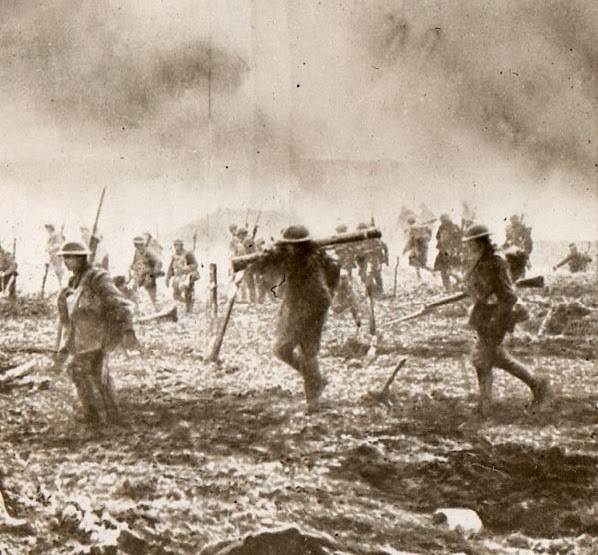
Gas! Gas! Gas!


It feels good to be back to working with this column again.  Once more, I cannot promise a regularity or frequency of posts at the moment due to my current schedule, but I will try to do the best I can to provide new content as often as I am able.  To that end, I’m cheating a little with today’s essay as it is pulled directly from new content I generated for the print version of “If Ye Break Faith.”  I don’t want to do this too often as I don’t want to give too much away, but I figured a sample chapter might whet some appetite.  I have not had much time to approach publishers with regards handling this work, and it isn’t quite complete yet; but I feel very close.  Good news from bad is that I have received first refusal from a prospective agent and am free now to shop the manuscript to whomever I would want to approach.

In the meantime, I am eager to increase my portfolio of completed work.  To that end, I am offering to work pro bono for the next while with any copywriting projects that may come my way-which is to say if you know anybody with some work needing done, please think of me.  Sending me a message through ifyebreakfaith@gmail.com would be the best way to contact me for short term copy projects at the moment.  Also, as mentioned in my last post, I am gearing up to offer my services as a military genealogist.  If you wish to know more about a Canadian relative who was veteran of the First World War, send a request through the above email.  Right now I’d be willing to interpret documents and military records for the cost of retrieving them from the archives, and any postage involved.  I’m relying on word of mouth alone for this start-up, so I appreciate you all in telling your friends.  Thank you.

Keeping up with this site and the project it supports can be done by following our Facebook Page, and Twitter Feed.  Any suggestions, questions or comments, please forward them to me here: ifyebreakfaith@gmail.com.


I tend to ask, when stuck for subject matter, a rather quick-fire question:  “What is the first thing that comes to mind when you think about the First World War?”  Surprisingly, no matter how many times I’ve posed that question to friends and relations, only one has answered “Poison gas; and its brutality.”
I think we have developed a cultural blind spot in the modern age to how widely this weapon was used during the war, have preconceived notions of its effectiveness and particular to those of us with a cultural bias towards the Western Allies most will decry the nastiness of the Germans for having used it first; with our subjectivity blind to who actually made the most prolific use of the various gasses developed in the war; Great Britain.

The Hague Convention, an 1899 conference and compromise between major European powers on the laws and conduct of war had resolved that the use of shells with the purpose of delivering asphyxiating gasses was to be prohibited.  Non-lethal gasses known as ‘lachrymatory’ or more commonly referred to as ‘tear gas’ was permitted by the Convention as it was seen as an aide to civil unrest.

It is supposed that the Germans, who first used chlorine against French Colonial troops on the 22nd of April 1915 in the opening phase of the 2nd Battle of Ypres, were attempting to side-step the Convention as they released this deadly gas via cylinders placed along their front lines as opposed to using artillery shells as a method of delivery.

As a surprise weapon against unprepared troops it was decidedly effective, causing the two French divisions to retire in panic.  This left a gap nearly four miles wide into the left edge of the salient and it was only a German failure to exploit this gain by having reserves close to hand to push through this breach that prevented a decisive breakthrough.  Two days later, the 24th, the Germans renewed their attack, this time against the Canadian Division which held the centre position at Ypres.  However in the intervening days, a simple expedient of using cloth soaked in water or urine to dilute the gas had already been set down as practice for the defenders.  This may destroy some notions that the use of such methods was a spontaneous measure enacted at the onset of the assault that morning.  The Canadian Division was able to hold their position and when reinforced on the left by British and Indian units were able to refuse the Germans any considerable gains.

Although the Western Allies protested this abuse of the Convention, a race was begun involving both sides to produce more effective gasses and means of delivery.  The first use of gas by the British was at their offensive at Loos on 25th September of the same year.  They too used chlorine dissipated via cylinder but a shift in wind direction made this deployment very ineffective. (Keegan 201)
While both sides attempted to outdo each other in the development of chemical weapons, they each in turn made progress in personal protective measures.  At its best, this was a respiratory device which used filters mainly of activated charcoal to negate the poison.  Colloquially these respirators became known as we still now call them- gas masks.

The very first use of asphyxiating gas was by far the most successful, but relied mainly on the shock and surprise of the new weapon rather than the casualties it caused.  “The chlorine gas originally used was undeniably cruel, but no worse than the frequent effect of shell or bayonet...statistics proved it the least inhumane of modern weapons.” (Liddell Hart, 145)  It is estimated that for the British, from official war records, gas was an accountable cause of death for 1.2 per cent of the total loss of life in the war.  This seems to waylay the overt idea of its lethal effectiveness, but let’s not forget that in such a war, a single percentage of fatalities is indicative of nearly 6 000 lives.  It is generally supposed that the use of chemical weapons on the Eastern Front was much more deadly, but poor records kept by pre-Revolution Russia and the confusion of the events for that country in 1917 have made accurate assessments difficult to determine.

Despite this fact, each major offensive mounted by either side for the remainder of the war was predicated with the use of gas in the ‘Fire Plan’ (the elaborate artillery preparation and bombardment prior to advancing the infantry.)  This should be taken into account that no one side which had access to chemical weapons and the means to use them desisted; even the Canadian Expeditionary Force.  We may think ourselves higher minded today but the language of our policy on Nuclear, Biological and Chemical Defence (NBCD) should be scrutinised.  The policy states that Canada would never initiate an NBC attack.  Nothing is stated on retaliatory measures and it would be a bit naive if we allow ourselves to believe our nation currently has not the means to do so.  Something to think about indeed.  

Two reasons dictated the perseverance of chemical weapons in the First World War.  The first was that neither side wished to cede a technical advantage, no matter how marginal.  The second may not be readily apparent.  Forcing one’s opponent to wear and operate in protective respiratory equipment by use of gas has a tremendous effect on their capabilities.  Gas masks, in order to work well have to be restrictive as to not allow any leak of poison.  The wearing of such devices dramatically reduces visibility and hearing and makes vocal communication incredibly difficult.  Even modern variants are terribly uncomfortable things to wear and work in.

It seems odd but we owe it to his experience of having being gassed in the First War which made Hitler forbid the offensive use of poison gas by his armies in the Second.  Perversely, though, it was also why gas was used as a means to enact his “Final Solution”, his government’s design for the eradication of European Jews and other groups the National Socialists deemed undesirable and therefore dispensable.  On the other hand, it should be taken into account that Churchill was fully prepared to use the incredibly lethal type of gas known as ‘nerve gas’ (where deadly exposure could occur with as little as a few micrograms breathed in or absorbed through the skin) in the event of German landings on British beaches.

Today, the present fear of use of biological or chemical weapons, what we now term “Weapons of Mass Destruction” dictates that the respirator and other protective clothing be a constant part of a soldier’s combat equipment.  Such is the legacy of terror of these weapons that the respirator is given priority over all other equipment.  A soldier in the field today may from time to time be without a weapon depending on tactical situation or not wearing their load-bearing equipment but they will never be without the pouch containing their gas mask.    

Wednesday, 1 May 2013

One, Two-Three, One


For the entre-nous this post’s title may not make much sense, but those of you with a military background in the British Commonwealth should understand it immediately.  It is a type of phrase candidates learning foot drill are required to call out in unison to properly gauge the timing of movements.  Typically, troops move on the “ones” and pause on the “two-threes.”  As an example, an “about turn”-a 180 degree change in direction faced- consists of two parts movement divided by on standard pause.  Therefore, the called timing would be “one, two-three, one.”

In the initial phases of training, these counts are vocalised until the timing is understood by all and the movement is being executed according to standard.  At this point, candidates are instructed to count the timings in their heads.  If it works correctly, the new troops will be able to march and drill with proficiency, synchronicity, and-more importantly to tradition- silently.  However, as often happens, lessons might not absorb on the first go ‘round and any slip from proper standard will be met with the instructor ordering the course remedially to call the timings out until standard be met again.

The analogy I’m reaching for here is that I’ve lost sight of what should be my standard, so I am going back to basics.  If Ye Break Faith began as a simple project with a clear goal:  To collect in one location short biographies of every member of the CEF killed on Active Service during the First World War. That goal has never changed, but has been sidelined bit by bit in an attempt to fashion some type of business from the fabric of what I had begun to create in order to fund the research and writing of these biographies.  The problem is, as my short venture in the travel business last year proved, I am not a commercially minded man.  I was bashing away at trying to force a square peg through a round hole, losing myself and the intent along the way.

Having had some time away from this-which my health concerns required- allowed me to reflect on what I needed to do.  First is to clean house and rid this space of content which confuses the overall purpose.  In looking into doing this during January of this year, I realised that the essays I had been writing and collecting here would fit rather nicely (if reorganised somewhat, tweaked and correctly referenced) as a book.  To that end, the print title “If Ye Break Faith” is very nearly complete.  I still have the long road to haul on finding a publisher to handle it, but it`s hoped that publication will enable me to push the biography aspect of the project ahead as it should be.  This means that some of the content of this site will be eliminated in efforts to not confuse first posts with the finished item as some of the differences are glaring.  It is also hoped that my first full-length publication will help me to produce more works on the remembrance of WWI.  The top of that list would be the proposed travelogue/walk with the past “Iron Spirits.”
Not having made full use of this space for a long time and having to reset a bit excites me as despite my inactivity, my network, particularly with Twitter (@ifyebreakfaith) has grown a great deal.  I’m enthusiastic to welcome new readers and hope still to bring inciting and insightful topics for thought and discussion.  This will be done concurrently as I grapple with exactly how and in what form the 60 00 0+ biographies will be written and collected; and a shortly to be announced side project to work on a freelance basis on military genealogy.  All I can say for the bios is that they will be collected online and publicly contributed to.  The genealogical work will be announced in full in an upcoming post.
This whole journey has been a learning process for me, and I’m certainly not discouraged by having made mistakes along the way which has necessitated a remedial action.  I cannot be because I think of this:
The decimation of the British Expeditionary Force in the autumn of 1914 coupled with the necessity of raising huge forces in Britain and throughout the Empire meant that certain standards of training could not be met when balanced against the requirement of quick deployment to prevent catastrophe on the Western Front. 
For the greater part of the hundred years preceding the BEF’s landing on the continent, Britain had been mainly engaged in limited conflicts within her own empire that could best be described by the euphemism “police action.”  Not discounting the Crimean or South African Wars, Britain’s reputation of a highly professional armed force had not  really been put to test.  The BEF,  the eve of war, was about to clash with a large host of whom some of the older officers would have had combat experience on the same ground they intended to cross.
War itself had changed.  While Britain was out “minding the shop” of Empire, the continental powers had formulated plans and incorporated tactics and technology for the very sort of war that was about to happen.  The only marked advantage that Britain had to hand was that the core of the BEF was full-time career soldiers meeting large bodies of recently activated reservists on the German side.  Unfortunately, it was an advantage that could only be used once.  The clash at Mons shattered the Regular Army and put in motion the need to push the Territorials and the New Armies to the front with all due haste.
These troops were, as events played out, adequate to operate in the defensive and in limited offensive works; usually in the need for localised counter attacks while the Front settled into its shape over 1915.  Major offensives such as those designed to win the war were another story.  The New Armies’ trial by fire at the Somme in 1916 showed glaring errors and oversights in organisation and training from the top down.  A great amount of time, effort and energy was spent in shaking things out and training the civilians turned soldiers to a level that the situation beforehand had precluded.  Lessons were learned absorbed and incorporated which would put the Allies in a superior position to claim victory in 1918.
The idea was, in one respect, lessons learned in lives lost.  Tactical doctrine having improved as time wore on indicates that the desire to conclude the war favourably was not predicated, as many would believe, on the wastage of human effort.  That a great amount of men died cannot be debated, but whether that number was greater or lesser than necessary is an argument without resolution.
The perseverance and dedication, even to the level of spending in lives cannot help but be wondered at, if not admired.  So, if I have to re-evaluate and adjust a broken notion, I can only hope to have the courage to do so.
To all of you who have expressed concerns over my health, I thank you very much for your thoughts and well wishes.  I’m pleased to say that my condition is in remission.  However,  have been ill for quite some time and as a result I’m undertaking a short course for educational and employment rehabilitation.  It is my hope that I will be able to keep close contact with If Ye Break Faith’s social network during this time but this, and updates to the blog may not be as frequent as I would wish them to be.  I appreciate all of your patience as I’ve worked through this difficult time and thank you all for sticking by and believing in what I’m doing.