If Ye Break Faith

This blog is dedicated to the promotion of educating about the Canadian experience of World War One. To discover who we are as a nation in the 21st Century, we must understand our past.


Thursday, 14 May 2015

With Maximum Speed and Aggression


It had been my intention to use this space to examine the shifts in the employment of infantry over the course of the war.  Envisioning a two-part series to illustrate these changes, it occurred to me that I had used the word “evolution”, which describes a gradual approach to change.  Two parts, I found, would be too abrupt to include all the relevant aspects, and as such I have decided to expand the series: Looking at the ultimate changes in tactics a little later on while spending some time now on elements of the war which served as an intermediary between things as they were at the start, and things at the war’s end.

The prospect of a long war was becoming more evident as 1915 wore on. 
Mutual defenses made for a delicate situation regarding offensive planning.  Only a large, well coordinated attack on as wide a front as possible could breach the enemy’s line; but the requisite numbers of trained men and adequate material support would not be met until med-1916, at least.  This left a large amount of time n which to plan and prepare for such a general offensive, sharing it with the requirement to prevent or defeat any similar offensive moves on the part of the enemy. 

In December of 1915, command of British forces on the Western Front was transferred from Sir John French to Sir Douglas Haig.  Haig’s despatches, from this point to the end of the war lend valuable perspective to the overall situation as seen from the very top.  His first such report, dated 19th May 1916 neatly describes the continual effort required to merely maintain the defensive lines- it “entails constant heavy work.  Bad weather and the enemy combine to flood and destroy trenches….all such damages must be repaired promptly, under fire, and almost entirely by night.[1] It must be taken into account that Haig’s despatches (which were publicly released in supplement to the London Gazette) have a decidedly positive spin.

This activity certainly occupied the infantry, but it would come at a cost.  Using the infantry in laborious tasks might ensure the men be kept busy, but time spent in this way reduced the amount of training such a large body of men mostly new to the army (or new to elevated levels of command) would need for a successful and complex operation that a decisive counter-attack required.  A lack of this preparation would become painfully obvious at the Somme in 1916.
  “At night,” says Professor Tim Cook, “the once empty battlefield...swarmed with activity.”[2] Even if no major effort to bring the fight to the enemy might be in progress, it mattered a great deal to military planners, reliant on accurate information as well as the morale of individual soldiers to control the battlefield.  There being no foreseeable opportunity for offensive operations for a period of several months indicated that the infantry would need the ability to retain a high level of morale and fighting spirit.  Holding a static position gave rise to the use of patrolling and trench raids to keep the men active while concurrently maintaining pressure against the enemy. Haig goes so far as to note “One form of minor activity deserves special mention, namely the raids…which are made at least twice or three times a week against the enemy’s line[3]  

To gain perspective of the enemy defences and overall intentions, patrols would be sent even closer to and sometimes within opposing trenches.  Such were the importance of patrols that if a compromise needed to be made between “facilities for observation (and) facilities for protracted resistance”[4] the latter took precedence if ample efforts could be made for patrolling. “Their strength may be from two to eight men under a non-commissioned officer.”[5] Active patrolling taught men how to act independent of larger commands, a crucial skill to inspire initiative and a good way to educate NCO's and junior officers who may have to assume control of a battle when attrition rates leave them senior.  Becoming familiar with the ground had great benefits in planning offensives and would help to raise the men's confidence during attacks.  
Raids differed from patrols.  The purpose was not to secure territory, but to cause a limited amount of damage.  They became the epitome of keeping men at a high level of aggressiveness, and to keep the enemy off balance and over vigilant.  Trench raids varied in size, from the numbers of a regular patrol to sometimes that which could be counted as a miniature battle.  One of the most successful raids, and one which would set the template for future operations and secure a peculiar reputation for Canadians, was conducted early in the war against German trenches near La Petite Douve Farm in November 1915 by the 7th Battalion, CEF.  Raids may well have been opportunistic, but a great many relied on exacting detail.  The operations order to the Petite Douve raid runs five pages in length and leaves very little to chance. 
The German section of line opposite the 7th Battalion was a meandering collection of sharp angles; its shape dictated by geography.  For the most part, their trenches ran generally north-south, parallel to and just west of a main road.  Where a quadrangle of buildings that was La Petite Douve Farm abutted this road, the German front line followed its outward edges. Nearly one hundred and fifty yards below the farm, the Douve River, running approximately west-east,
intersected the road.  At this point, the trenches crossed the road at a right angle and continued along the river’s path, on the northern edge of the road in an easterly direction.  The raid was to target this particular corner, as it was believed this section would be easy to isolate for a short period at least.  An added bonus would be capturing the machine gun post believed to be emplaced at the crux of the trench’s angle at river and road.  Battalion commander Lt Col Odlum set down the number of men to embark upon the raid, and what their specific jobs would be.  Captain L J Thomas was in overall command of the operation, and he would be headquartered in the forward Canadian trench with a twenty-three man reserve force to be moved up in case of heavy resistance.  The small group of men, less than seventy all told going into No Man’s Land were divided into three groups.  Twelve men and an NCO made up a support team which would occupy a listening post (LP) on the north bank of the Douve.  A covering party, of nine men and two NCO’s were to protect the makeshift bridges of which there were two that would enable the assault party to cross.  Four officers, two NCO’s and thirty six men were part of the assault party.  Under the command of Lt A Wrightson*, theirs would be the difficult task. 

On the night of 16-17 November, 1915 the 7th Battalion, according to the operations order, would attack, (with a concurrent effort of the 5th Battalion) “2 points in the enemy’s lines opposite its front for the purpose of draining strength & gaining information concerning his defences.”[6] Leading up to the operation, artillery fire was expected to cut the German wire and damage their trenches while trench mortars fired upon Petite Douve Farm intending to knock out machine gun emplacements there.  In the afternoon and evening of the 16th, rifle fire from the front trenches would be used to keep the enemy fixed in place, preventing use of communications trenches, with the noise of gunfire covering the sound of the attacking party moving into their jumping off positions.  Scouts had gone ahead in the afternoon as a two man patrol “to endeavour to make a daylight report on the success secured by the artillery in cutting the enemy wire and breaking the parapet.”[7]  With this report, further patrols went out with bridging ladders to the determined crossing points and placed them there for the attack team.  At eleven o’clock, the attack team assembled in the forward trenches.  Beforehand, they had removed all identifying information such as id discs, paybooks and uniform insignia.  Each man wore a black “veiling mask” to reduce visibility, and make quick identification possible.  It could also be surmised the use of these masks was to have a psychological element upon the unsuspecting Germans.
H-hour was 11:30 pm.  The attack team moved out through gaps cut in the Canadian wire and traced along the right bank of the Douve, led by the scouts who had determined the route to the bridging point.     Once in place, the support team took up their positions at the listening post, the covering team moving over the bridge.  Midnight was when “the assault will be delivered from the bridging point.”[8]  With maximum speed and aggression, the assault team crossed the river, guided by scouts to the breached wire.  The artillery hadn’t been completely successful and wire cutters were employed to widen the breach.  Once in the trench, one group moved down the length of the trench to the left, clearing their path with hand grenades.  At a predetermined point, just beyond the junction with a communications trench, bales of wire were dropped and men with shovels went to work to create a barricade. The remainder of this group carried on down the communication trench to the support line, lobbing grenades the whole way. Another group had moved right, towards the machine gun position, taking it by force and setting up a similar block as the one on the left. The men then made their way into the support trench, meeting up with the team that had come down the communication trench.  Within minutes, the assault team had effectively taken control of a rectangular portion of enemy line defined by the bent fire trench at the road, the communication trench and the length of the support line which ran between the fire trench and the communication trench.
Twelve German prisoners were manhandled out of the trench and back towards the support team at the LP.  While several riflemen kept ready in case of a sudden counter attack from the direction of Petite Douve Farm, any valuable information, including the construction and outlay of the trench system was taken in by the scouts who were moving within the cordoned area.  Exactly twenty minutes after the assault team had made their breach; Lt Wrightson blew one long and three short blasts on his whistle, to agreed signal to withdraw.  The assault team, again guided by the scouts made their way through the wire, gathered the bridge party, crossed back to the right bank to rendezvous with the support team and then back into Canadian lines.  A pre-arranged artillery salvo was fired upon the German line where the assault had taken place.  The Germans had put a counter-attack in, but were too late, the enemy had gone and they were now exposed to heavy fire. 
The Petite Douve Raid was a tremendous success.  At the cost of one man killed and another wounded, the party of men of the 7th Battalion had struck a fierce blow against a defended line, taken a dozen prisoners and gained credible intelligence.  It would make the reputation of the battalion, and of the Canadians as daring “raiders”; which also inspired other Canadian units to mount raids of their own in a spirit of one-upmanship.  These subsequent raids improved on technique and helped to solidify the overall esteem of Canadian troops.  The effect of such an operation would be enormous.  It would first inspire confidence in the men taking part of their own abilities and their leadership.  A successful raid showed them that the enemy could be taken by surprise and kept the ever crucial fighting spirit at a keen edge.  Also, the enemy would be unbalanced, forcing them to improve their vigilance for such attacks, which wears on physical and psychological limits; especially if there was a prospect that men in black masks could drop into a trench at any given time.  Information brought back, through prisoners and the observations of the assault party would go towards the planning of future operations.


*Lt Wrightson being given command of the assaulting team is remarkable, considering he is listed as a Private in “D” Company in the Bn’s nominal role taken upon arrival in England just one year prior.


[1] Lt Col J H Boraston, ed. “Sir Douglas Haig’s Despatches (December 1915-April1919)” J L Dent & Sons Ltd. 1919 pg 4
[2] Cook, Tim, “At the Sharp End: Canadians Fighting the Great War 1914-1916” Penguin Canada, 2007 pg 272
[3] Boraston, ibid.
[4] General Staff, War Office, “Field Service Regulations Part I: Operations” HM Stationary Office, London, 1909 pg 100
[5] General Staff, War Office, ibid. pg 110
[6] Odlum, V W, Lt Col: 7th Battalion CEF Operation Orders No. 59, 15 November 1915; Appended to Battalion War Diary, courtesy Library and Archives Canada
[7] Odlum, V W, ibid.
[8] Odlum, V W, ibid.

Friday, 8 May 2015

To Close With and Destroy the Enemy


This is the role of the infantry, one such which has remained constant even in light of the technological and tactical advances in warfare.  In this two part series, If Ye Break Faith will examine how this role has changed little, but evolved much; how the post-industrial battlefields of WWI necessitated a large part of this evolution which introduced concepts still employed today without fundamental adjustment to doctrine which remains immutable.

It is ultimately to the infantry to seek a decisive result from battle.  It is this responsibility pared with those unique aspects of an infantryman’s experience
which allows a certain pride of place of the infantry within the military.  “It is he who must seize the ground and hold it.  And he must do this on foot, armed with only what he can carry at the mercy of the elements and over every sort of terrain.  There is nothing remote about war for the infantryman.  For him war has always had a very personal dimension.”[1] The infantry fulfills its role by use of the technique known as “fire and movement.”  Ultimately, “The main essential to success in battle is to close with the enemy, cost what it may”[2]  Fire and movement makes this possible.  By overcoming the enemy’s resistance, with superior firepower the infantry are able to press forward.  It might seem deceptively simple, but as the two tasks are undertaken concurrently, in reality this is a very complex task which requires-has always required- a great deal of control and coordination. [3] Such control can only be gained through training and repetitive drills.  This is accomplished by first smaller units perfecting their role before working in higher formations.  Practicality is the reverse of this.  The attack, by use of “fire and movement” is an exercise in diminishing values.  A divisional attack, for example, will use its artillery assets to allow the forward brigades to advance under fire.  The brigades likewise employ their own gun- with a little more precision than the division barrage- directed against the brigades’ objectives and so let the component battalions gain further approach, and so on down the line of company, platoon and section. The 1909 British Army Field Service Manual makes this notion clear “All leaders, down to those of the smallest units, must endeavour to apply, at all stages of the fight this principle of mutual support.”[4]

The process of bringing superior firepower onto the enemy is itself known as “winning the firefight.”[5] No matter the important placed on this, in itself it is just a means to an end.  Winning the firefight is what enables the infantry to move to “closing distance” from the enemy where the assault to destroy him will be carried out.  Equally matched opponents and strong defensive positions meant that this crucial step of the attack was far more difficult to achieve, almost to a point of futility during the war.  Adjustments would be required, but it would take some hard lessons to inspire them.  Textbook dictates and rehearsed technique are put in place not particularly to instill inflexibility in employment, but create such familiarity with doctrine that there is room for initiative and improvisation which the battlefield requires.  With insufficient grounding in these fundamentals the likelihood of a successful infantry attack are greatly diminished.

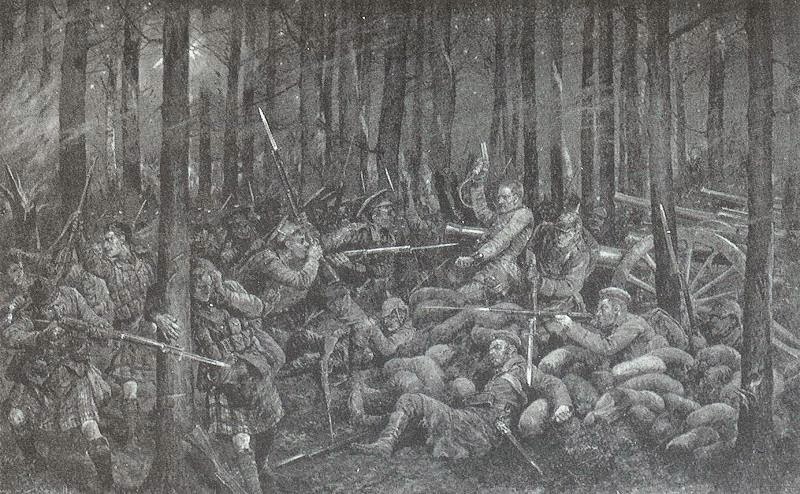
A curious example would be to look at the counter-attack towards Kitchener’s
Wood made by the 10th and 16th Battalions, First Canadian Division late on the first day of the 2nd Battle of Ypres.  German gas attacks against French Colonial units to the left of Canadian positions had driven the defenders out of their trenches, leaving a clear path towards the immediate objective of St Julien, and the Canadian flank exposed.  In one way, the gas worked too well.  German infantry in pursuit of the fleeing French Algerians had gone much further forward than the initial advance had meant to.  These point units were supposed to have established a new defensive line to allow follow up forces to jump off for the assault against St Julien.  Instead, they had pressed into Kitchener’s Wood.  While four British guns had been captured, the Germans were too few in number and dangerously over-extended.  If an aggressive counter-attack could be made quickly, the Germans might be caught out.  Two conditions in this proposal worked against the Canadians; that they had yet to mount such an attack in earnest, and it would have to be done at night.  The 16th Battalion had come up to 3 Brigade HQ at St Julien from reserve positions outside of Ypres, a route march which took hours to complete, the 16th arriving by 2200hrs[6].  This battalion would be supporting the 10th Battalion’s assault on a German trench at the south end of the wood.  Once this was taken, both battalions would move into, and clear out, the wood itself.  From the Division’s 2nd Brigade, the 10th Battalion made up of men from Western Canadian (Calgary and Winnipeg, mostly) Militia units would be leading the advance; its four companies lined up two abreast and two deep.  Behind them the 16th (Canadian Scottish; an amalgamation of pre-war Highland Militia regiments) would follow in the same formation. The simplicity of the formation was accounting for the unknown ground the men would be moving over in the dark; the best solution for inexperienced officers to retain tight control of inexperienced men. Each battalion was under the ultimate command of its Colonel, but no appointment had been made for overall command of the attack.  This oversight would make for costly consequences.

German penetration had come as far forward to a built up area known as “Oblong Farm” to the southwest of the Canadian’s trench line objective.  Lt Colonel Leckie of the 16th Bn suggested his 10th Bn counterpart, Lt Col Boyle detach some elements to keep the farm under suppressing fire.  Interpreting his orders too literally, Col Boyle didn’t consider operating on initiative and decided to go forward without isolating Oblong Farm.  His orders, from General Alderson had made no mention of the Farm, only because Alderson had no information on it.  The ground over which the Canadians would attack had not been properly reconnoitred.  “Artillery support was provided by a British battery and the 9th and 12th Batteries of the 3rd Brigade CFA (Canadian Field Artillery), firing on the northern part of the wood and beyond.”[7] This made a total of thirteen guns supporting a two battalion attack by firing at a point well beyond the primary objective.  It would hardly be adequate in either volume or area- a vital part of “winning the firefight” would then be absent from this attack.  Nevertheless, the Canadians were enthusiastic, Lt Col Boyle quipping “We have been aching for a fight and now we are going to get it.”[8]

“During the advance in the darkness over unknown ground companies and platoons lost cohesion.”[9]  The two battalions set off at 2345hrs.[10]  This made a turnaround time of six hours from the initial German attack to the Canadian counter attack.  While this may have seemed quick work at the time, but it was hardly efficient.  German soldiers had made excellent use of the interceding hours in digging hasty defenses and bringing forward machine guns.  Within the first fifteen minutes, 10th and 16th Battalions closed half the distance to the objective, facing minimal incoming fire.  Ordered to advance in complete silence to obscure their presence had aided in this good start.  At about the mid-point, there was discovered a fence line which had to be gotten over.  The noise of men and their equipment struggling over this obstacle alerted the Germans- both in the objective to the front, and from Oblong Farm which was now in a position to provide enfilading fire on the Canadians.  This fire was heavy and hitting the attackers on front and flank.  Out of place, in broken and mixed formations the final 300 yards was closed by rushes.

The initial attack against the trenches outside the wood were carried by the
weight of the assault.  Hand-to-hand combat was frequent.  Casualties were higher than they should have been.  Against reason, objectives were met.  With the exception of a pocket of German positions within the wood, the trench had been taken, the woods occupied and the four lost guns re-captured.  The two attacking battalions had lost about two thirds of their strength, inclusive of most of their officers- among them Lt Col Boyle who had been fatally wounded by a German machine gun.  German casualties were considerably lighter[11].  It is difficult to credit the success of the attack based upon the conditions in which it was made.  Perhaps it could be said that it succeeded more from the Canadians not knowing the odds against them.  In any analysis, Kitchener’s Wood had so many factors going against it that it wouldn’t be considered a well-executed attack- even by contemporary standards- except that the attackers had made their objectives. 

A latter day General, Brigadier General Vernon who once commanded Land Forces Central Area (Now 32 Canadian Brigade Group) offered this observation which might fit as mitigation as to why the attack at Kitchener’s Wood went as it did: “Field Marshal Slim…noted that the Army as an institution is an inverse pyramid: everything depends upon the skill, motivation and determination of the individual soldier.” This may be why novice soldiers can still achieve under circumstances which would usually project failure.  Such actions, like it was at Kitchener’s Wood are usually very costly.  Standards of proficiency-at all levels- would be required; along with the required adjustments in doctrine in keeping with the evolution of modern war.  Within two years the Canadians would have incorporated the lessons of this action, among others which would allow them to be capable of a Corps sized infantry attack- that of Vimy Ridge.


[1]Soldiers: A History of Men in Battle”, BBC Television, 1985.  Episode 5: Infantry (written by Richard Holmes & presented by Frederick Forsythe)
[2] General Staff, War Office, “Infantry Training 94- Company Organization) 1914”, HM Stationary Office, London, 1914 pg 134
[3] The Infantry Journal, Inc. “Infantry in Battle”, Washington DC, 1939 pg 223
[4] General Staff, War Office, “Field Service Regulations Part I: Operations” HM Stationary Office, London, 1909 pp 135-6
[5] Authority of Chief of Defence Staff, “Platoon and Section Commander’s Aide Memoire”,B-GL-309-003/FT-201, 1981 Section 3.2
[6] Zuehlke, Mark, “Brave Battalion: The Remarkable Saga of the 16th Battalion (Canadian Scottish) in the First World War”, John Wiley & Sons, Canada, 2008, pg 51
[7] Nicholson, GWL, Col. “Official History of the Canadian Army in the First World War” Queen’s Printer, Ottawa, 1962 pg 66
[8] Zuehlke, Mark, ibid. pg 55
[9] Nicholson, GWL, Col ibid.
[10] Greenfield, Nathan M, “Baptism of Fire: The Second Battle of Ypres and the Forging of Canada, April 1915” HarperCollins 2007 pg 98
[11] Cook, Tim, “At the Sharp End: Canadians Fighting the Great War 1914-1916” Penguin Canada, 2007 pp 127-8

Friday, 17 April 2015

A Most Terrible Day

This article, including original source material (letters, diaries and photographs) and particularly the input of BGen Greg Young was made possible through the gracious assistance of the 15thBn CEF Memorial Project ; a voluntary organisation dedicated to preserving the history of this proud regiment.

Battalion HQ, Farm “ARBRE” April 24/15. “Enemy attacked our line of trenches (front line, adv HQ & St Julien).  Heavy casualties.  Weather- fine & warm.”[1] That terse assessment, in less than twenty words describes the single highest one day loss of effective strength of any Canadian Battalion in the entire war.  After months of training at Valcartier in Quebec and a miserable winter on Salisbury Plain in England, the 15th Battalion (48th Highlanders), along with the rest of the 1st Canadian Division had taken to the field in France, along the Western Front.  There had been a short period of work up training with British units but by April the Canadians were operating on their own.  Assigned a “quiet sector” the 1st Division took possession of trenches just outside of the Belgian village of Ypres.  The 15th Battalion occupied front line positions on the 20th.

A lot has been made of the Canadian’s performance at the 2nd Battle of Ypres.  Much has gone down in the annals of history as a fine feat of arms; a foreshadow of the great national achievements yet to come in the unfolding years of the Great War.  There remains little doubt that despite terrible odds and a terrifying new weapon that the 1st Canadian Division held a succession of lines during the battle which prevented the Germans from breaking through to the town of Ypres. 

A battle on the scale of 2nd Ypres is fluid, involving thousands of men in different units along a varying landscape and changing circumstance over several days.  Looking at events broadly might bring a wide perspective and a general comprehension of the battle.  Examining it from the point of view of a single unit, over the span of a single day will certainly overlook key dynamics of events, but may help in understanding the experience.  This type of focus can tell more, perhaps, about how men behave under fire-in this case under fire for the first time.

The battle had begun on the afternoon of the 22nd when the Germans opened
cylinders of chlorine gas against the French divisions opposite them, to the left of the line occupied by the 1st Canadian Division.  The immediate result was a complete collapse of the French lines.  There was now a gap, nearly four miles wide, in the Ypres salient, and very little between the three German divisions following the gas cloud and the village of Ypres itself. 

These events were only on the periphery of the men of the 15th along their section of line, which they had occupied since the 20th.  Any word that was getting to these forward units was fragmentary-incomplete and confusing.  What was understood was that the 13th Battalion (Royal Highlanders of Canada) to the left of the 15th which had shored up with the French units now departed, had become the left edge of the salient and “that the entire left flank of the Canadian position was now in danger of being 'rolled-up',” says BGen Greg Young of the 15th Bn CEF Memorial Project.  The initial collapse had been blocked by the British 13th Brigade supported by the 10th and 16th Canadian Battalions.  This formed a ragged line sweeping west south west from the Royal Highlanders’ left elbow to the Yser Canal. “The entire line from the Canadian boundary with the 28th Division near Gravenstafel round to Kitcheners Wood was now manned by the equivalent of eight battalions.  These were to be attacked by at least three times their number of German Battalions.  The 5th and 8th Battalions (of the 2nd Brigade) and the 15th Battalion held the original front on the east side of the Salient.”[2]  

The ideal place for an attack in a scenario such as this would be to do so at the least defensible portion of line, close to the apex of the salient so that it could be easily enveloped, and if possible near to a command boundary.  The 15th Battalion were, to their misfortune, exactly in this type of place.  Of four companies (from positions right to left), No’s I, III and IV were in the line, No II Company being held as Battalion reserve outside of St Julien.  Captain McGregor, Officer Commanding (OC) No I Company was on the far right , abutting (with a hundred yard gap between) the 8th Battalion, marking the boundary between the 3rd  and 2nd  Brigades.  Major Osborne, OC No IV
Company tied in with a company of the 2nd Buffs who stood in between the 15th and the 13th Battalions to their left, the Buffs having the dubious position of a narrow apex, in a place that would come to be known as “Devil’s Corner.”  It was difficult ground and no proper trench line existed. “The line resolved itself into a series of strong points.”[3] This disposition had the effect to isolate the Battalion’s companies from one another. Gen Young notes that this was “the result of having to occupy a French style trench system based on platoon sized, forward facing redoubts connected with shallow communications trenches.”  Major Osborne described his company’s disposition: “The arrangements here were somewhat different than on former occasions.  Two platoons only were kept in the first line trench, while the remaining two were kept in reserve at Battalion Advance Headquarters.  In addition the position of the Company Commander was not in the trenches, but in a dugout about two hundred and fifty yards to the rear, and connected to the main trench by a communication trench.”  He continues “Our section consisted of two redoubts about 30 or 40 yards apart and connected by an earthen screen about 3 feet high.”[4]

April 23/15-“Enemy shelled trenches and St Julien and Adv Bn HQ.”[5]The 15th Battalion’s officers had all done what they could to make their positions more defensible, building up with sandbags or even relocating to better ground.  Constant shelling had prevented movement, particularly of getting the wounded out and rations and ammunition forward; several probing attacks had determined the point for the next advance.  Orders had been to “stand to the end,” and each man would have prepared himself for what that might mean.  Early in the morning on the 24th, it was “evident that the Germans were through some of the gaps and were well behind the 13th Battalion.”[6] This infiltration threatened Major Osborne’s position will possible surrounding from the rear.    “This danger was very real for the entire forward line. Equally of note, the entire backside of the 15th line was exposed to fire - both MG and artillery, from the exposed left flank, made all the more dangerous by the lack of a parados at the rear of their trenches.”-Gen Young.
  
Lt Maxwell-Scott, of 11 Platoon, No III Company, to the right of Major Osborne’s company describes what he witnessed that morning “We stood to at 3a.m., Sat. morning.  Shortly after 3.30, when it was fairly light, we noticed far away on our right front a German captive balloon which hadn’t been there the day before.  As we watched it four red stars were dropped from it, making quite a pretty sight.  Our gaze must have lingered a little too long, for when I turned the men were leaving the trenches on our right and a great wall of green gas, about 15 to 20 ft. high was on top of us.”[7]  The renewed attack fell upon the divide between the 8th and 15th battalions.  Although much narrower than the gas attack on the French days before it was more concentrated, and thus just as effective. Gen Young provides further information on an increasingly desperate situation:  “the 15th Bn was only unit in line that had no artillery support. Their supporting battery, unknown to them, had been withdrawn out of range.”


Here, the popular image is played of stalwart defenders in urine soaked kerchiefs pouring deadly fire into the advancing enemy despite the wisps of pure chlorine all about them.  It is almost certain that events here were much different.  Those units hit by the gas, No I Company and the right edge of No III Company of the 15th and the left edge of the 8th were of little use in the ensuing battle.  No I Coy “was annihilated.  Two or three men were seen staggering back ...but they were so badly gassed they had to be helped to the rear.”[8] Lt Scott recalls of No III
Coy “it was hopeless to try and stand up against the stuff, so we returned, choking, coughing and spluttering.  There was a hill behind us, and up this we went in small groups.  We hadn’t been there long before the shells started coming and for about 7 hours they shelled us most unmercifully, the shells dropping all around, some hitting the parapet, some going just over, causing a good many casualties.”[9]  Lt Scott would be evacuated to hospital before days’ end.

With the Front line reduced and now consisting of small isolated groups, the concurrent assault from the left flank tore up the remains of “Devil’s Corner.”  The German’s attacks were pressing the right areas and isolating trouble spots created by a fragmented line.   No I Company’s positions were vacant from the gas, and were being used by German infantry to roll up the right flank of the 15th Battalion.  Those of No III Company who could get away did, either to the rear or further left to join IV Company positions.  The two forward platoons of No IV Company were attacked on all sides, and left little option.  Says Major Osborne, trying to keep to his order to stand, “More of the enemy however must have come across further to the right, for they came down  the trench in considerable numbers....considering the situation more than serious made my way to Company H.Q. to try and get a message to Major Marshall for reinforcements and more ammunition.”[10]  This he was unable to do, his telephone lines were cut.  So, “I sent Pte Odd out with Pte Wilson to try to get through on foot with a written message.  Whether they were successful or not in getting out I do not know as I never saw them again.”[11]  Major Osborne, who was twice wounded, had tried to move his men back into a more defensible position, but this proved of little use as No III Company had indeed been surrounded.  He and his party were taken prisoner by about 25 Germans. 

The last position along this line, being commanded by Lt MacDonald- an amalgamation of 15th Battalion men and the remnants of the Company of the 2nd
Buffs- having suffered heavy casualties and run out of ammunition surrendered. “I want to call attention,” Maj Osborne would later write, “to the splendid work of Lieut. Fred MacDonald.  His judgement and foresight as well as his steadiness and nerve in the face of very critical and trying circumstances on the 24th...was most praiseworthy.”[12]

By 9:30 in the morning the 15th Battalion had lost the majority of its three front line companies. A hard fight at St Julien, which had started with the Germans moving in from the west, and then supported by their comrades moving south from the reduced front line involved No II Company and elements of the forward lines who had managed to fall back in good order.  The small village was quickly cut off and surrendered by noon. 

As night drew in and the day came to a close, the artillery in the gun line providing an artificial twilight with the flash of each shot, the 2nd Battle of Ypres was over for the 15th.  They were moved off, a collection of souls more than a regiment to the GHQ line where they would remain throughout the next day, going into support lines further south, beyond Ypres itself on the Monday.

Monday, the 26th of April, 1915, when Quartermaster Sergeant Stevens “called the roll of stricken No I Company.  Six men answered.  The whole regiment numbered about 150- less than 200 when the band and transport were included.  That out of 912 effectives....The casualties of the Battalion...were: 20 officers and 651 other ranks.  Of these, 5 officers and 218 other ranks were killed or died.”[13]

Professor Tim Cook notes “Within this chaos the Canadians continued to remain an effective fighting force.”[14] This observation wasn’t just self generated, praise for the 1st Canadian Division came from the highest levels:  “In spite of the danger to which they were exposed, the Canadians held their ground with a magnificent display of tenacity and courage, and it is not too much to say that the bearing and conduct of these splendid troops averted a disaster” said Field Marshall Sir John French, British Commander in Chief. [15]

For the 15th, they may be deserving of Field Marshall French’s praise, but could not be fitted into Professor Cook’s assessment. Of the more than one thousand men who had set off in high spirits from Toronto eight months prior, only slightly more than ten percent could be counted as effective after their first day of battle.  Three long years of war remained before them, and would be faced by a very different, rebuilt, 15th Battalion.


[1] 15th Battalion CEF War Diary via Library and Archives Canada
[2] Nicholson, G.W.L (Colonel) “Official History of the Canadian Army in the First World War” Queen’s Printer, Ottawa 1962 pg 71
[3] Beattie, Kim, “The 48th Highlanders of Canada, 1891-1928” pub. 48th Highlanders of Canada, 1932 pg 55
[4] Osborne, J. Ewart (Major), Personal letter to Lt Gen. Sir Richard Turner, 1918
[5] 15th Battalion CEF War Diary via Library and Archives Canada
[6] Beattie, Kim, ibid. pg 64
[7]Maxwell-Scott, Herbert (Lieutenant), Personal account, date unknown
[8] Beattie, Kim, ibid. pg 72
[9] Scott, ibid.
[10] Osborne, ibid.
[11] Osborne, ibid.
[12] Osborne, J. Ewart (Major), Appendix to Personal letter to Lt Gen. Sir Richard Turner, 1918
[13] Beattie, Kim, ibid. pg 79
[14] Cook, Tim At the Sharp End Penguin Group (Canada) 2007 pg 161
[15] Greenfield, Nathan M., “Baptism of Fire”: The Second Battle of Ypres and the Forging of Canada, April 1915,Harper Collins 2007 opening leaf